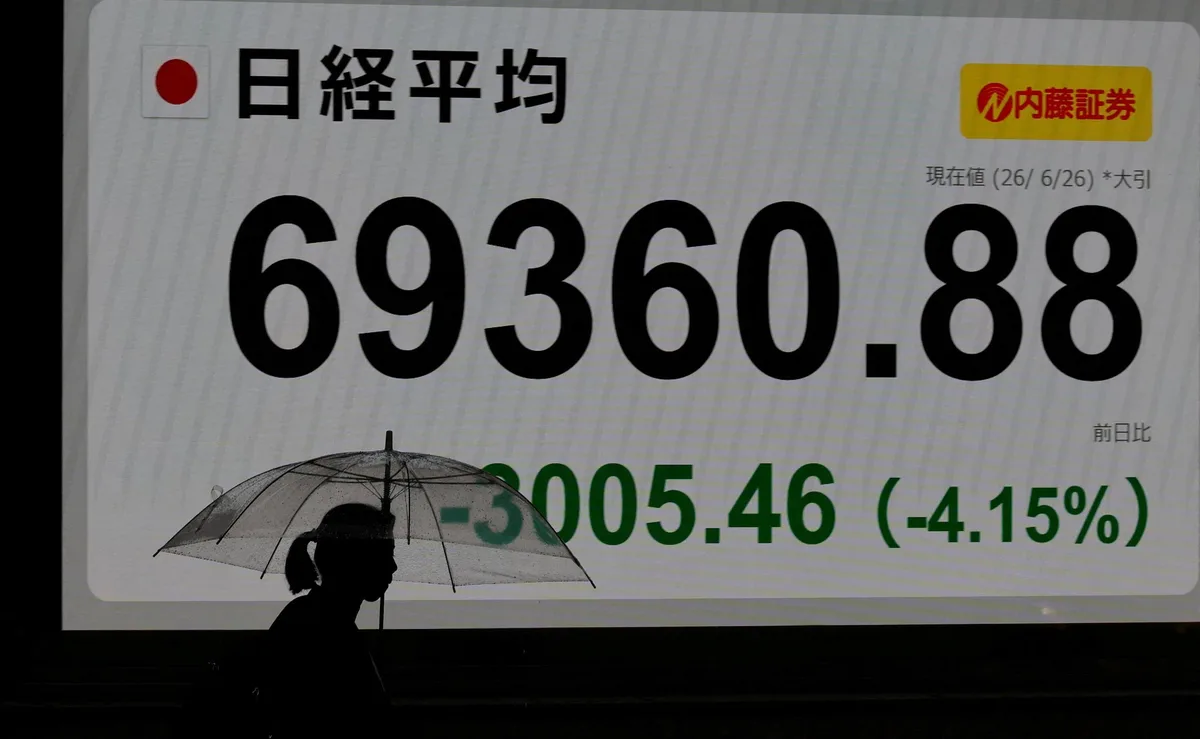
South Korea's primary stock index, the KOSPI, fell sharply by 6.37% on July 20, 2026, closing near 6,820 points. The plunge followed renewed US military attacks against Iran, which raised geopolitical tensions and pushed Brent crude oil prices above $90 per barrel. This inflationary pressure compounded losses in the technology sector, as major semiconductor stocks Samsung Electronics and SK Hynix faced severe selling pressure. Both companies, key suppliers of AI chips, make up over half of the KOSPI's weighting, giving their share price swings outsized influence on the broader market decline [1, 2, 3, 4, 5].
The sell-off was intensified by high leverage in ETFs, derivatives, and margin trading linked to AI chip stocks, which triggered mechanical liquidation cascades. This led to heightened market volatility, with the KOSPI's implied volatility index reaching an historic high of 97.99 during July. SK Hynix’s US ADR listing in mid-July was followed by a more than 15% collapse in its Korean share price, raising concerns about market instability and attracting regulatory scrutiny of leveraged trading products [3, 4, 5].
Following the sharp drop, the KOSPI staged a partial rebound on July 22, rising about 6%, driven by bargain hunting and programmatic buying across the chip sector. Samsung and SK Hynix led the recovery, supported by foreign institutional investors re-entering the market after the initial panic. Despite the rebound, the index remains over 25% below its June 22 peak, and market participants remain cautious amid ongoing geopolitical risks and inflation concerns [6, 7, 8, 9].
Across the region, Taiwan’s stock markets also tumbled in mid-July, with semiconductor giants such as TSMC suffering similar declines amid concerns over AI demand and geopolitical uncertainty. In contrast, Chinese AI chip-related stocks surged, with the STAR 50 index rising more than 10% on July 22 as investors rotated into China’s semiconductor sector [1, 2, 10].
US tech companies including Alphabet and Tesla have announced plans to significantly increase capital expenditure on AI infrastructure, expected to benefit Asian chipmakers like Samsung and SK Hynix. However, analysts caution that investor focus is shifting from mere resilience to growth prospects sufficient to support high valuations. Ikuo Mitsui, fund manager at Aizawa Securities, noted, "The market has already undergone a fairly substantial correction. At the same time, corporate earnings have held up reasonably well and have proved more resilient than expected." Meanwhile, Bret Kenwell of eToro said, "The burden of proof has changed. Investors are no longer asking whether companies can withstand the uncertainty. They want growth and guidance strong enough to justify elevated valuations." [11, 6]
SK Group Chairman Choi Tae-won commented on supply concerns, saying, "Memory chip prices are abnormally high and supply needs to increase to reduce prices. SK Group is actively seeking suitable locations in the US for semiconductor fabs." [5]
Looking ahead, market participants will watch closely for further developments in geopolitical tensions and corporate earnings updates. Regulatory agencies are expected to review leveraged products linked to volatile chip stocks, and the near-term path for KOSPI will depend on investor appetite amid these risks.