Bitcoin passed the $80,000 mark for the first time in over three months on August 25, reaching a peak near $81,257 during Asian trading before settling around $80,700 [1, 2, 3]. The cryptocurrency posted its largest weekly gain in more than three years, rising roughly 23% in the week ending August 23 [4, 1, 5, 6].
The rally was triggered by the US Treasury's announcement on August 19 to at least double its purchases of long-term bonds, a move that pressured yields lower and weakened the US dollar [4, 1, 2, 3, 5, 7, 8]. "The Treasury’s announcement hit Bitcoin right where it counts. Bitcoin is designed for investors to hedge against this sort of intervention," said Geoff Kendrick, head of digital assets research at Standard Chartered [3]. Despite the announcement, Treasury Secretary Scott Bessent said on August 24 no bonds had yet been bought [2].
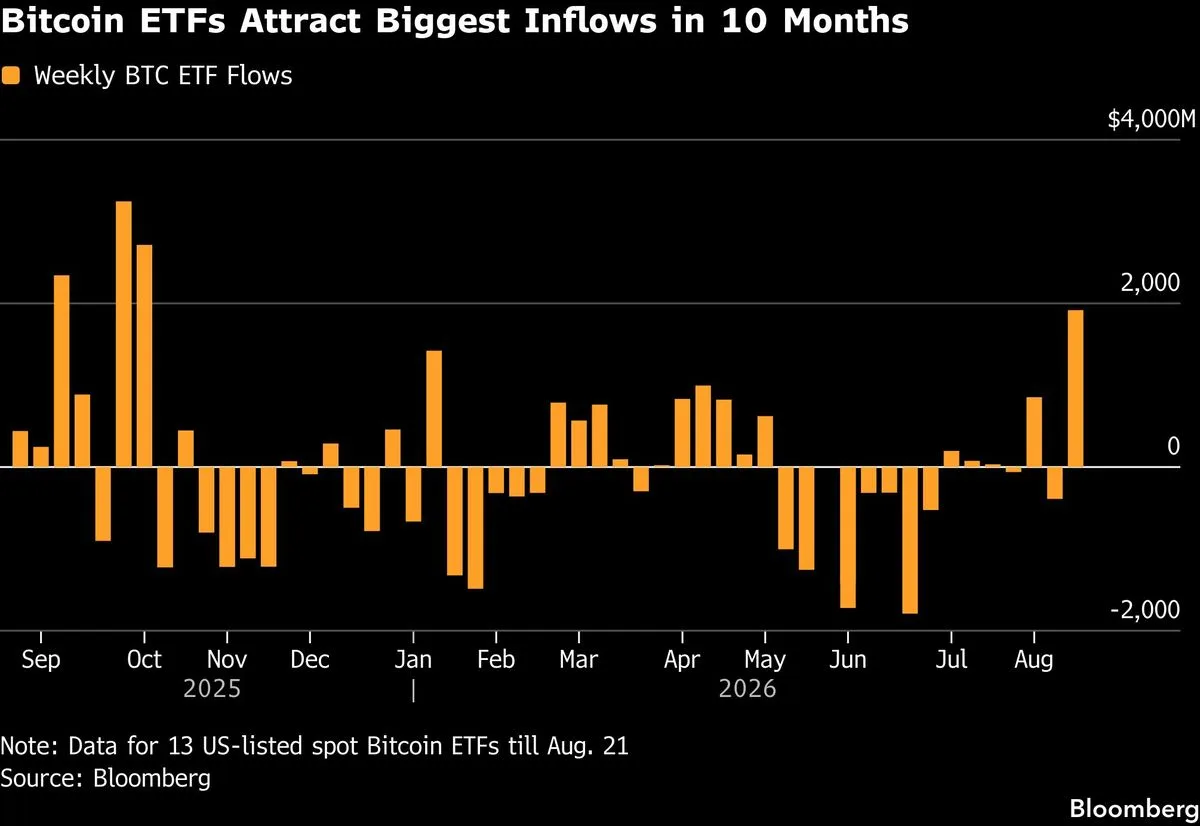
Bitcoin spot ETFs recorded inflows of $1.92 billion in the week ending August 23, the highest in 10 months [4, 1, 6]. BlackRock’s iShares Bitcoin Trust accounted for $1.3 billion of that total [4, 9, 6]. Coinbase shares rose 11% on August 19 amid shifting US regulatory policies and a White House crypto summit [10, 7, 9].
The rapid Bitcoin price surge forced many bearish traders to close short positions, with liquidations estimated between $2.7 billion and $7.2 billion during the rally [1, 2, 5, 9]. Jayke Kyndrede, a senior sales trader at QCP Group, said the market looks stretched but supported, warning of possible consolidation: "After such a rapid move, some consolidation or retracement would be unsurprising but the timing and depth are difficult to call while demand remains strong" [4].
Ethereum also rose sharply, with ETH spot ETFs seeing inflows of over $512 million in recent days [11, 9]. The weakening Japanese yen amid ultra-loose monetary policy may have added support for crypto as a hedge asset [11].
Despite the surge, Bitcoin remains about 36% below its $126,000 all-time high reached in October 2025 [1, 5, 8]. Large holders reportedly sold nearly 7,700 BTC, worth roughly $577 million, in late August, suggesting some profit-taking [9]. Gracie Lin, CEO of crypto exchange OKX SG, noted that renewed investor interest showed through daily net inflows but cautioned, "After such a strong move in bitcoin, some profit-taking wouldn't be surprising" [4].
Analysts raised Bitcoin price targets to $84,000 and possibly $88,000 if it maintains gains and ETF inflows continue [2, 8]. Year-to-date, Bitcoin ETFs saw net outflows of about $2.9 billion despite last week's reversal of nearly $390 million in outflows [4, 6].
Bitcoin’s next key test will be holding above the $80,000 level as traders watch ETF flows and price action for signs of sustained momentum or a pullback following an RSI near 81, signaling overbought conditions [2, 9].