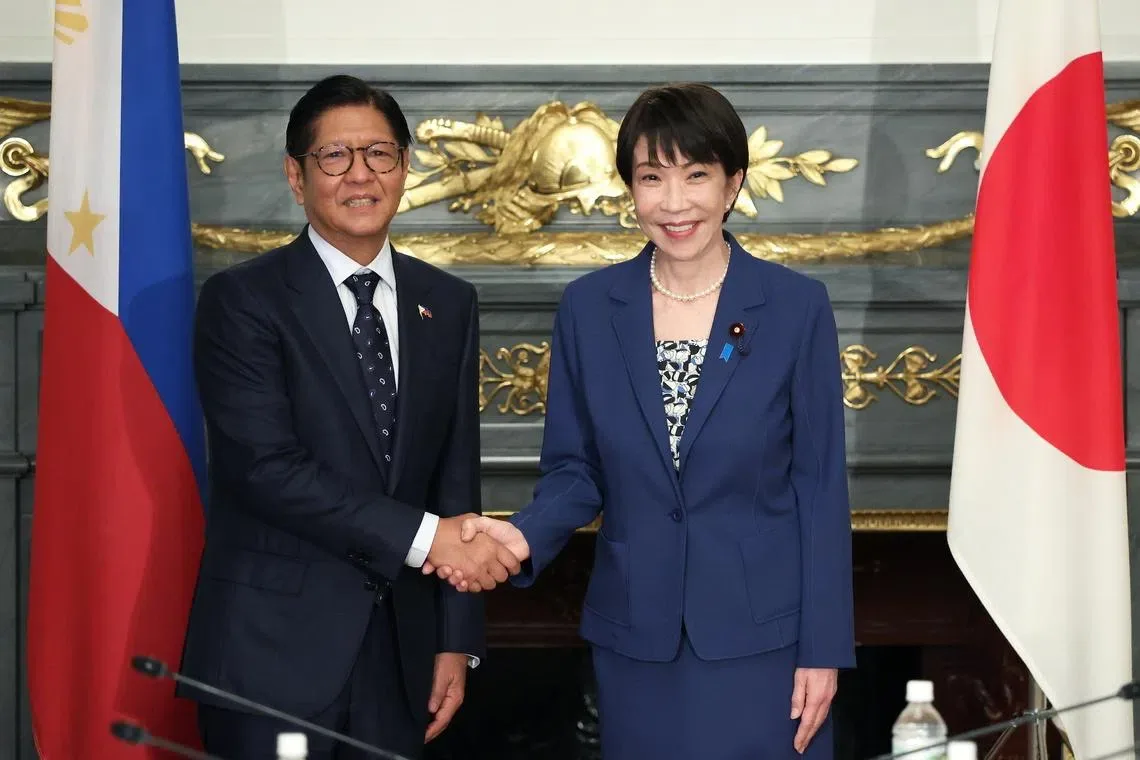
Japan and the Philippines agreed on May 28 to begin talks on a General Security of Military Information Agreement (GSOMIA) and the formal delimitation of their maritime borders amid concerns over China’s regional assertiveness [1, 2, 3, 4]. The announcement came during a joint press conference in Tokyo with Japanese Prime Minister Sanae Takaichi and Philippine President Ferdinand Marcos Jr [1, 2, 3, 4]. Marcos was on a four-day state visit to Japan, his first in over 10 years, coinciding with the 70th anniversary of diplomatic relations between the two countries [1, 2, 3, 4].
The intelligence-sharing pact aims to establish protocols for exchanging and protecting sensitive military information between the two nations [1, 2, 3]. Marcos said, “We jointly announced the commencement of the negotiation for the General Security of Military Information Agreement (GSOMIA), as well as for the delimitation of our maritime borders. These are very important steps to further strengthen our defence cooperation and to uphold a rules-based maritime order” [1]. Prime Minister Takaichi added, “We will continue to deepen cooperation with the Philippines to address the increasingly challenging strategic environment in the region” [1].
Japan already holds similar GSOMIA agreements with the US, Australia, and South Korea, while the Philippines signed one with the US in 2024 [1, 2, 3]. The two countries also agreed to speed up talks on transferring six Abukuma-class destroyer escort vessels to the Philippines. These vessels, commissioned between 1989 and 1993, would mark Japan’s first export of lethal weapons under revised defense export policies [1, 2, 3].
The maritime border delimitation talks will formally define overlapping claims between the nations amid shared worries about China’s activities in the East and South China Seas [1, 2, 3]. Earlier groundwork to enhance military ties included a Reciprocal Access Agreement effective since September 2025, allowing mutual access for joint exercises and disaster relief, followed by an acquisition and cross-servicing agreement signed in January 2026 [1, 2, 3].
The two countries elevated their partnership to a "comprehensive strategic partnership," just below a formal alliance, announced during Marcos’s visit, which included a rare address before the Japanese parliament [4].