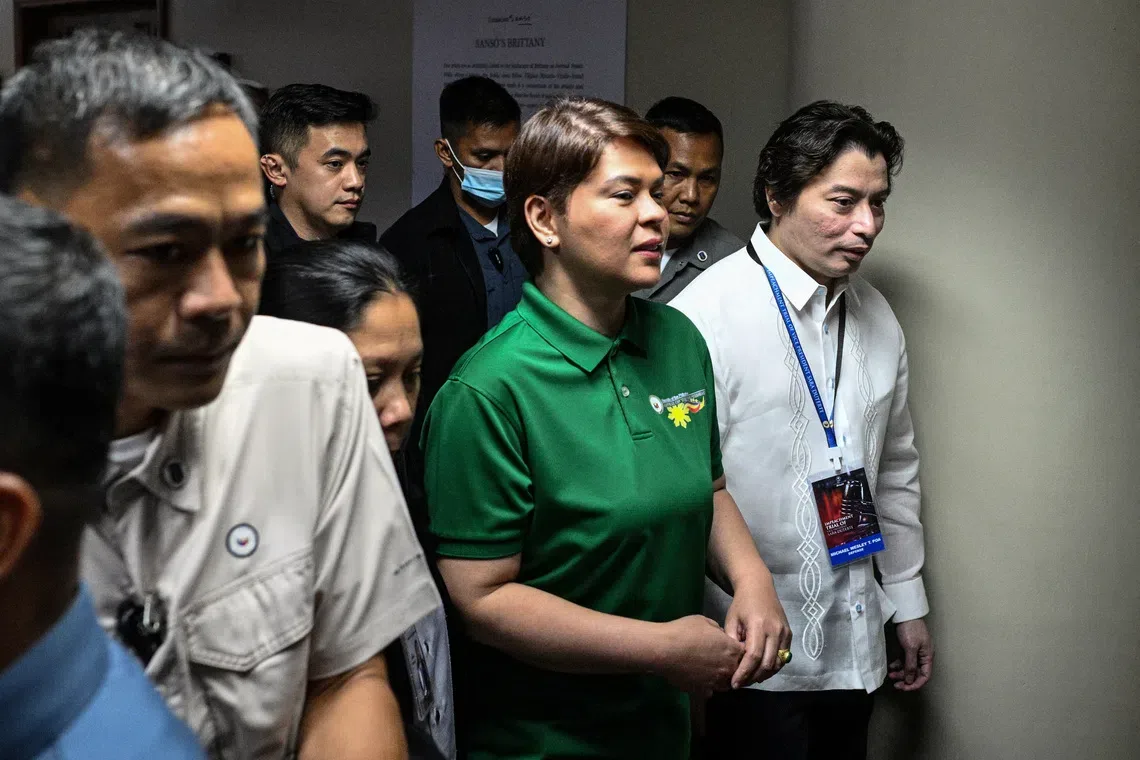
The Quezon City Regional Trial Court issued an arrest warrant on September 4, 2026, for Vice President Sara Duterte on three counts of grave threats against President Ferdinand Marcos Jr., First Lady Liza Araneta-Marcos, and former House Speaker Martin Romualdez [1, 2, 3]. The court set bail at 120,000 Philippine pesos (approximately US$1,900 to S$2,400) for each count [1, 4, 5].
The charges arise from remarks Duterte made in November 2024. She said she spoke to a hitman and instructed him to kill Marcos, his wife, and his cousin if she was killed first [1, 3, 5]. The Philippine Justice Department filed the grave threats charges in August 2026 following a National Bureau of Investigation inquiry [5].
Despite the warrant, the court dismissed a motion to defer its execution [2, 6]. Sara Duterte's lawyer stated she has no intention of evading the law and will exhaust all legal remedies, including applying for bail and challenging the warrant in higher courts. "Regardless of the question on jurisdiction, she has no intention of evading the law and will continue to exercise all her legal remedies," her lawyer said [1, 3].
Under Philippine law, the grave threats charge carries a maximum sentence of six months imprisonment [2, 3, 6]. The Justice Department confirmed the filing of charges and the issuance of the warrant, rejecting claims that Duterte cannot be prosecuted criminally while under impeachment proceedings [3, 6, 7].
The criminal case is separate but related to the impeachment trial now underway in the Philippine Senate that could remove Duterte from office and bar her from running for president in the 2028 election [1, 4, 5]. Duterte, daughter of former President Rodrigo Duterte, is considered a leading contender for the 2028 presidency [3, 5].
The political relationship between Duterte and President Marcos Jr. has deteriorated since their 2022 election alliance [5]. Marcos’ office said it "respects any decision of or directive from the court" [8].
Legal experts say Duterte could quickly file for bail without appearing in court and potentially appeal the warrant to the Court of Appeals or Supreme Court [3]. The next concrete step will be her formal arraignment and consideration of bail.