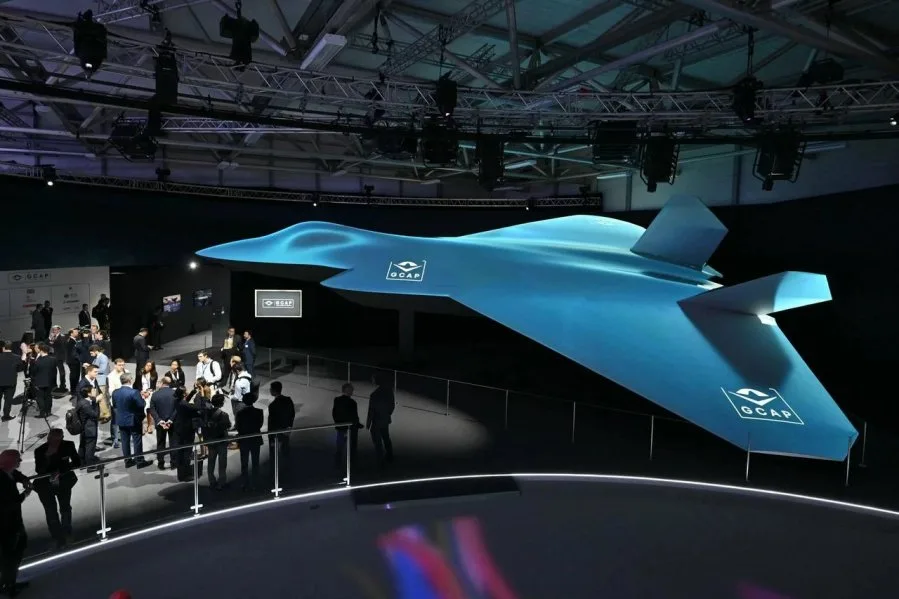
The UK, Italy, and Japan finalized a £4.6 billion (approximately $6.1 billion) contract on July 3 or 4, 2026, to develop a next-generation 6th-generation fighter jet under the Global Combat Air Programme (GCAP) [1, 2, 3]. The contract was awarded to Edgewing, a joint venture formed in June 2025 by British BAE Systems, Italian Leonardo, and Japanese JAIEC, to lead execution of the program [1, 2, 3].
The GCAP fighter jet is planned to enter service in 2035 and will incorporate artificial intelligence and advanced technologies. It is designed to operate alongside existing 4th and 5th generation aircraft as well as autonomous systems, expanding the combat capabilities of participating air forces [1, 2, 3]. According to a British government statement, "The GCAP fighter jet will work alongside Typhoons, F-35s and autonomous systems as part of a next-generation Royal Air Force. The aircraft will use complex digital engineering, AI and ground-breaking technologies to be the most advanced fighter jet flown by the RAF" [2].
Funding for the contract is jointly provided by the three governments. The UK recently announced a Defence Investment Plan committing £8.6 billion over four years to GCAP and related projects, including upgrades to 4th generation Typhoon fighters and procurement of F-35 jets, to maintain a mixed fleet through the 2040s [1, 3]. Deliberate development is also underway for autonomous unmanned aerial vehicles to cooperate with manned fighters. The UK has allocated £300 million for the "Collaborative Combat Aircraft" (CCA) project aiming for flight demonstrations by 2030 [1, 3].
Edgewing's partners are separately developing the fighter's airframe, avionics, and engines, with the XFP30 engine being developed by Rolls-Royce, Avio Aero, and Japan's IHI [3]. Okamoto Shinomi, GCAP programme director, said, "This programme will help the three countries share development costs, technology advantages and create high-tech jobs" [3].
The UK views the GCAP program as contributing to regional security in the Indo-Pacific [1]. The joint contract signing marks a major step in collaboration between Europe and Asia on advanced military aviation. The fighter jet’s debut is expected by 2035, with continued development milestones and flight tests planned in the coming years [1, 2, 3].