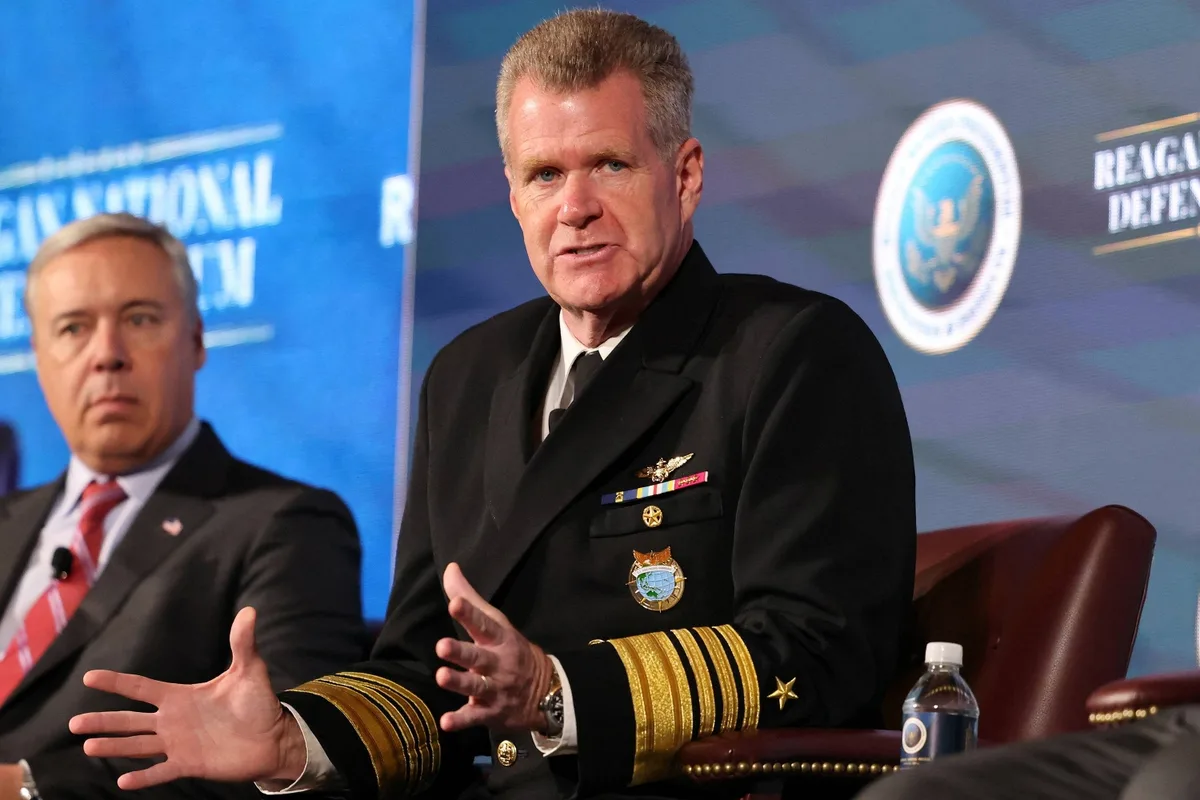
The US military is pursuing new weapons to deter or fight China over Taiwan, including warship-killing bombs and advanced sea mines, according to a report to Congress on April 6, 2026 [1, 2, 3]. Admiral Samuel Paparo, head of US Indo-Pacific Command, said China’s People’s Liberation Army (PLA) is undergoing a historic military expansion and preparing for two key missions: forcing Taiwan’s unification and countering US and allied defense capabilities, aiming for military readiness by 2027 [1, 2, 3]. He stated, "China’s People’s Liberation Army is undergoing historic expansion across all domains and is training for two primary missions: forcing Taiwan unification and countering US and allied defense capabilities, with military readiness targeted by 2027" [1].
The request for the 2027 US defense budget totals $1.5 trillion, a 44% increase over the previous year’s budget authorized under the Trump administration [1, 2]. This includes $592 million for the Quicksink program, which adds kits to Boeing’s GPS-guided Joint Direct Attack Munition bombs to convert them into low-cost, all-weather anti-ship weapons that detonate beneath a ship’s keel to sink it [1, 2]. Admiral Paparo described the Quicksink as a "low-cost, all-weather anti-ship weapon capable of sinking vessels by detonating beneath the waterline to break the ship’s keel" [2].
The Quicksink kits are designed to help counter China’s numerically superior navy, which has more than 430 ships compared to 291 US combat vessels [1, 2]. Another major program, Quickstrike, requests $531 million to develop shallow water mines that can be deployed from aircraft against surface and subsurface targets [1, 2]. A third effort, called the "Clandestine Delivered Mine" program, uses existing submarines to place mines covertly [1, 2].
The 121-page report dated April 6 repeats that 2027 is the key timeline for PLA readiness, coinciding with China’s 100th anniversary [1, 2, 3]. However, an earlier 2026 intelligence assessment softened Pentagon predictions that China would attempt a Taiwan invasion by that year [1, 2]. The report’s language is notably tougher than the previously more conciliatory tone of the Trump administration’s stance on Beijing’s military intentions [1, 2, 3].
Admiral Paparo warned, "We must defend the homeland and defeat China’s misaligned strategy" [1]. The US Congress will review the 2027 budget request as part of the national defense authorization process.