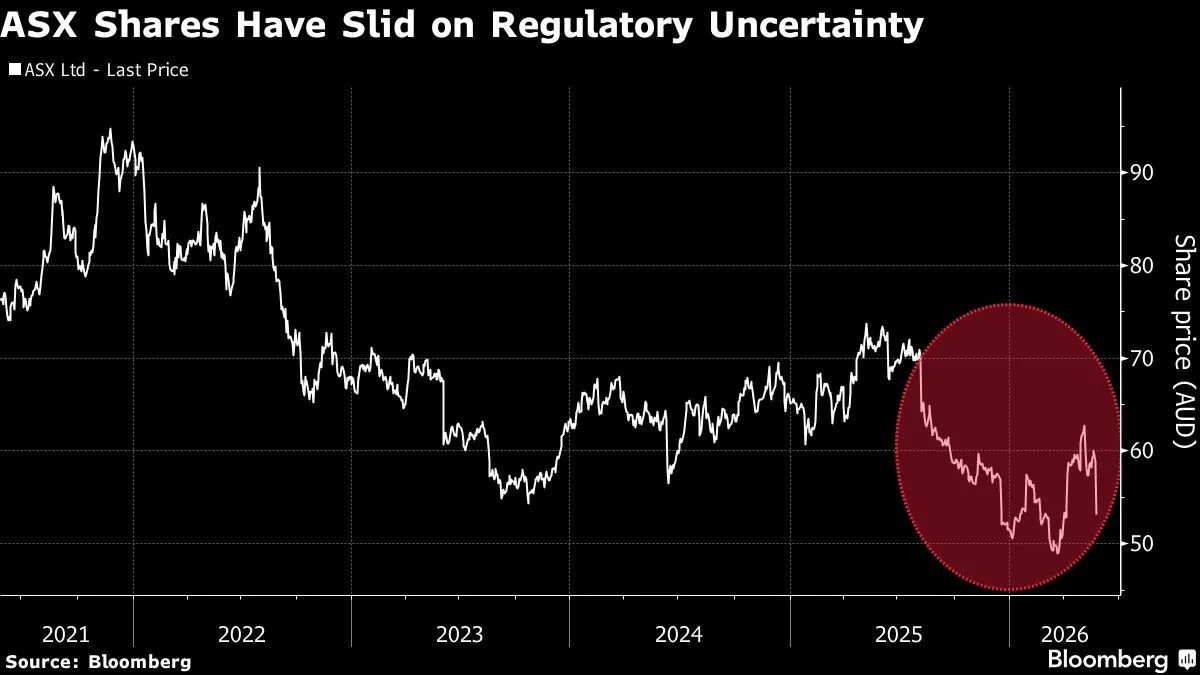
ASX Ltd shares plunged as much as 13% on May 26, marking their biggest drop since August 2012. The selloff followed the company raising its capital expenditure guidance for the 2027 financial year to between A$180 million and A$200 million, up from a previous range of A$160 million to A$180 million [1, 2].
The higher spending is tied to ASX's ongoing technology modernization program, including upgrades to its CHESS clearing and settlement platform. The upgrades reflect compliance with regulatory requirements stemming from a probe by the Australian Securities and Investments Commission (ASIC) [1, 2].
ASX expects total expense growth of between 18% and 21% in 2027, and issued its first capital expenditure guidance for the 2028 financial year of A$170 million to A$190 million [1, 2]. The technology upgrade program, which ASX plans to complete by 2029, is aimed at enhancing infrastructure reliability and meeting regulatory standards [1].
In response to the increased costs, ASX also lowered its dividend payout ratio to between 75% and 85% for at least the next two dividend payments, while discounting its dividend reinvestment plan [1, 2]. It trimmed its medium-term return on equity target from 12.5%-14% to 12%-14% [2].
ASX’s shares have fallen 27% over the past 12 months, representing the worst performance among major global exchanges [1]. Despite this, the company reported a 12.5% rise in unaudited operating income for the year ended April 30, reaching A$10.3 billion, driven by robust trading and derivatives volumes [2].
Rachel Waterhouse, CEO of the Australian Shareholders’ Association, said, “The scale of the cost growth and increased capital expenditure guidance will rightly raise questions for investors about execution risk, cost discipline, returns on investment and impact on dividends.” [1]
ASX continues to focus on completing its technical upgrade program, with the CHESS settlement system overhaul expected by 2029 [1].