Australia’s government is pushing ahead with a A$94 billion (US$66 billion) high-speed rail project intended to tackle housing affordability issues and boost economic growth [1, 2]. The new High Speed Rail Authority, established to oversee the project, has received a preparatory budget of US$462 million to design and plan the initial stages [1, 2].
Tim Parker, appointed as the first head of the Authority, brings experience from major infrastructure projects including Hong Kong’s Eastern Harbour Crossing and Sydney Harbour Tunnel [1, 2]. He said, "Everything has come together — and we’ve got a government that wants to do it. This can be delivered, and should be delivered" [1].
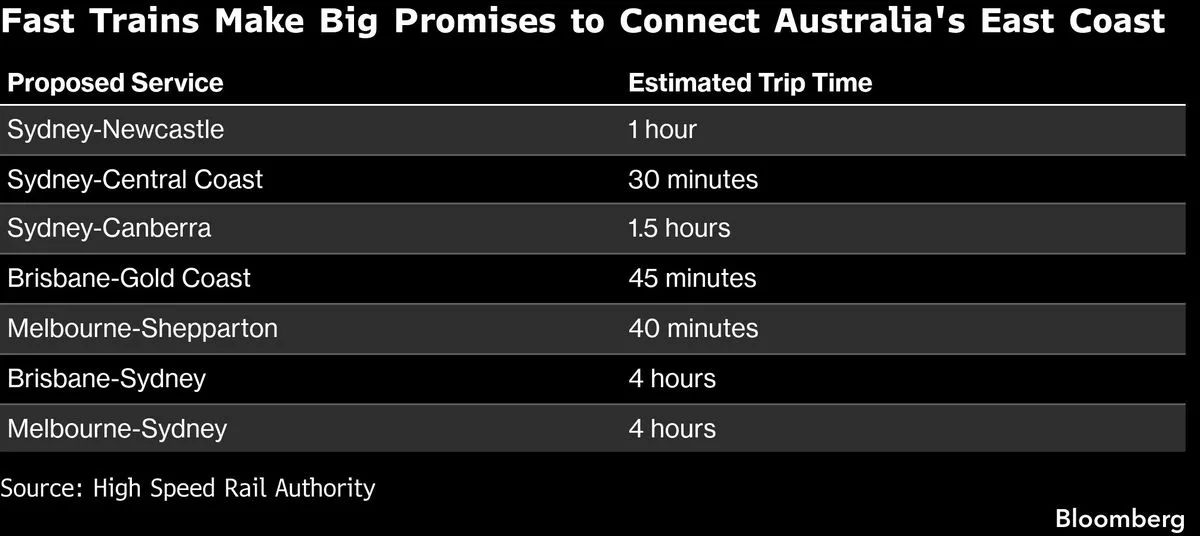
The first phase focuses on building a 194-kilometer high-speed rail line between Sydney and Newcastle. This route aims to reduce travel time to 60 minutes, significantly cutting commute times [1]. Forecasts project that it could support the creation of 160,000 new homes and 99,000 jobs in the region. Over 50 years, the project is expected to add around A$250 billion to the economy [1].
The long-term vision is an extensive 1,800-kilometer rail corridor connecting Brisbane, Sydney, Canberra, and Melbourne by 2060. Trains would run at speeds up to 320 km/h, linking Australia's biggest east coast cities [1].
Despite the optimism and government backing, the plan has faced false starts in the past. The project still requires final government approval before construction can begin [1, 2].
On June 12, 2026, the government announced the US$462 million preparatory budget specifically for planning the Sydney-Newcastle bullet train line [1, 2]. The next step is completing detailed design and securing all necessary approvals to move construction forward.