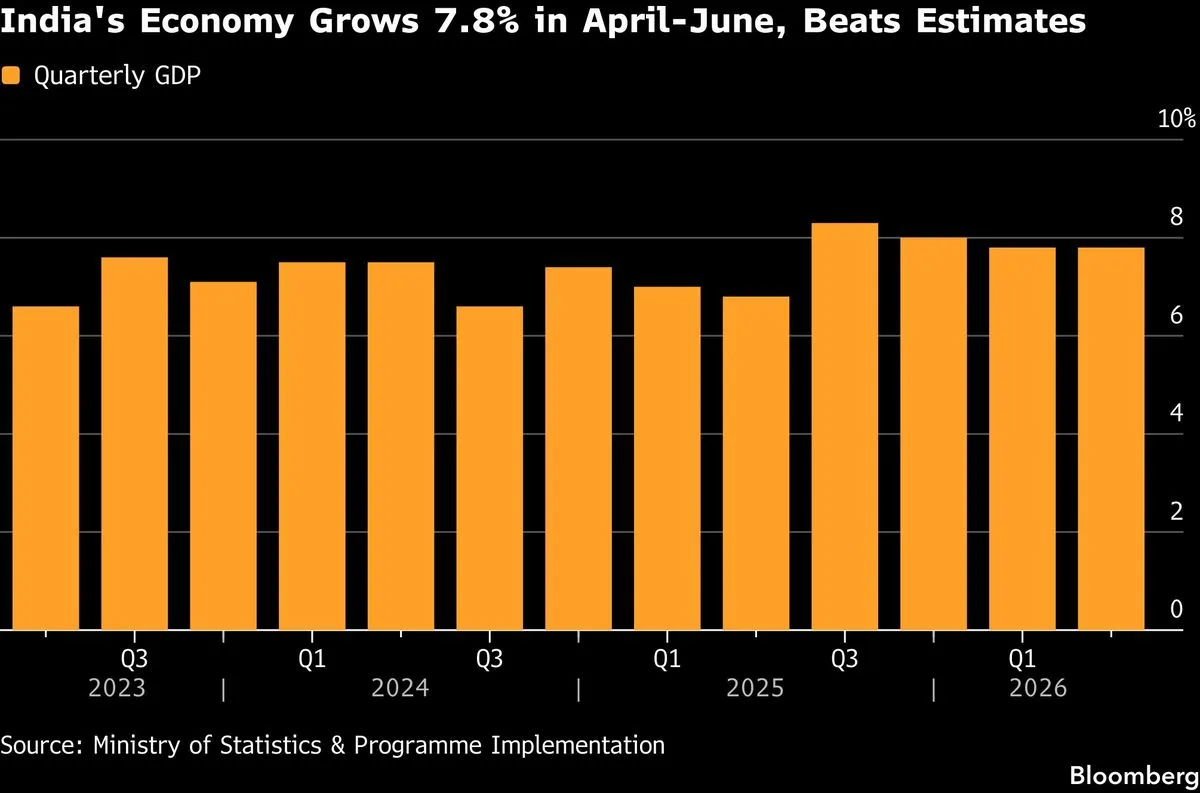
India's economy grew 7.8% in the April-June 2026 quarter compared to the same period last year, official data released today showed [1, 2, 3]. This growth matched the previous quarter's pace, which some sources revised up to 8.6% [2, 3]. The expansion surpassed the Reserve Bank of India's forecast of 7% for the quarter [2].
Key sectors driving growth included finance, real estate, information technology, manufacturing, and financial services [1, 2, 4, 5, 3]. Manufacturing grew 9.2% and financial services expanded 12.1% during the quarter [2]. Gross fixed capital formation, a measure of investment, rose 11.9%, reflecting expanding business spending [2]. Consumer demand remained robust, with private consumption up 7.1% [2].
India's government has implemented economic measures to support growth, including consumption tax cuts starting in September 2025 and following the outbreak of the US-Israel-Iran conflict at the end of February 2026 [1, 4, 5, 3]. Despite the Iran war pushing energy prices higher and increasing import bills, domestic demand helped offset these pressures [2, 3]. The statistics ministry said, "India’s economy has sustained growth momentum despite global headwinds" [3]. HDFC Bank economist Sakshi Gupta noted that "a broadly steady monsoon should also help limit risks to rural demand" [2].
India maintains its status as the world's fastest-growing major economy amid geopolitical shocks [2, 3]. The Reserve Bank of India projects 6.7% growth for the full fiscal year [2], though the government’s target of 9.25% annual growth to reach developed-nation status by 2047 remains distant [2].
The rupee stood at 95.17 INR per US dollar before the data release [2]. The next key economic update will be the GDP report for the July-September quarter, expected late this year.