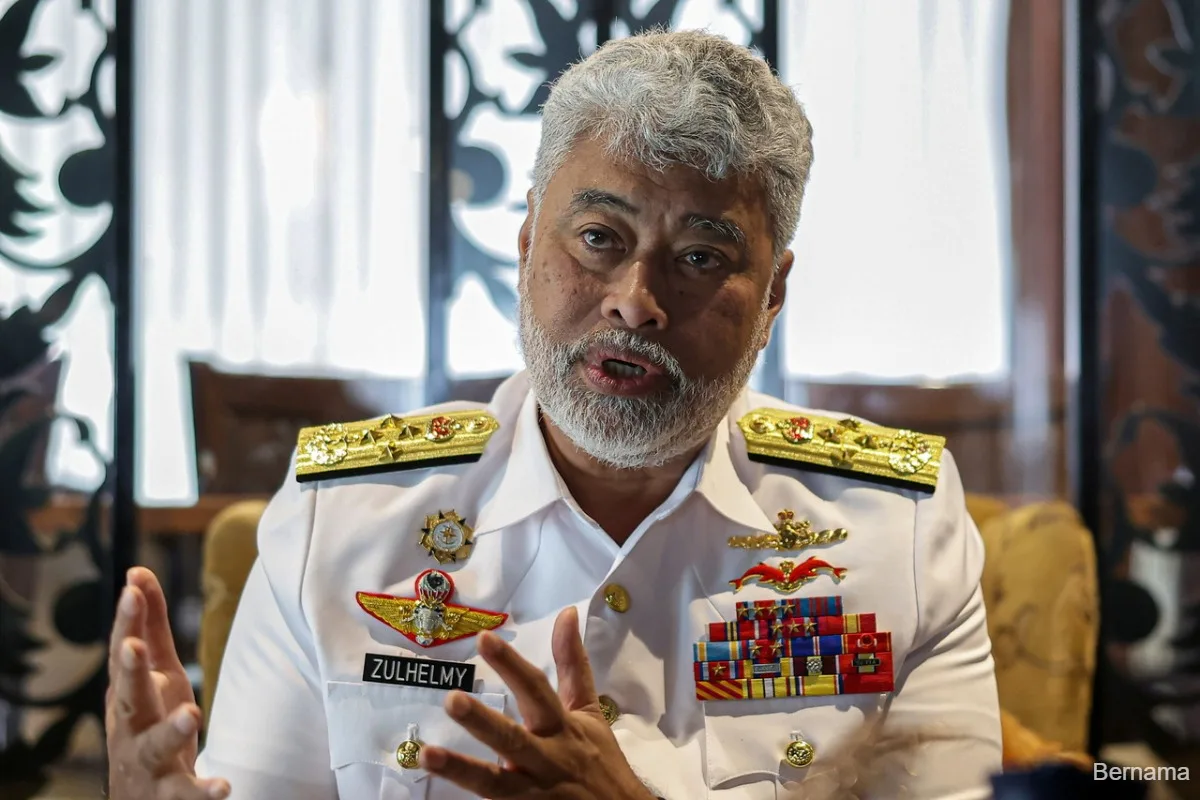
The Royal Malaysian Navy (RMN) faces significant challenges as over 60% of its fleet consists of vessels older than 40 years, raising concerns about operational readiness and maintenance [1, 2, 3, 4, 5]. At a July 2 briefing, RMN chief Admiral Tan Sri Dr Zulhelmy Ithnain stressed, "More than 60 per cent of our assets are over 40 years old. They are obsolete. This is one of the navy's biggest challenges today." He added, "These ageing ships still have to go to sea, and as the leadership, we are concerned because their condition is no longer the same as when they first entered service" [2].
Among the oldest ships are four Perdana-class Combat vessels, converted from missile boats to patrol vessels, which have served for over 50 years [1, 2, 4]. Two of these, KD Perdana and KD Ganyang, are currently undergoing an asset obsolescence management program to reinforce their hull integrity. This program is expected to extend their operational life by 10 to 15 years as an interim measure [1, 2, 4].
The older vessels require mostly corrective maintenance rather than preventive, which increases costs and leads to frequent breakdowns [1, 2, 4]. This is a key driver behind RMN's "15-to-5 Transformation Programme," which aims to streamline the fleet from 15 ship classes down to five main classes. The goal is to improve operational readiness and reduce maintenance burdens [1, 2, 3, 5].
Under the 13th Malaysia Plan, RMN plans to procure two Multi-Role Support Ships (MRSS), with a third to be built locally in line with the transformation plan. The MRSS acquisition project has government approval and is in the proposal evaluation stage, with submissions from over 17 countries including Russia, China, the Netherlands, Turkey, Italy, and South Korea [1, 4]. Admiral Zulhelmy stated, "We require two MRSS under the 13MP, but the target under the RMN 15 to 5 Transformation Plan is three vessels, with the third to be built locally" [1].
Submarine acquisition is planned under the 14th Malaysia Plan to further enhance capabilities [1, 4]. The RMN intends to maintain a "fleet-in-being" concept targeting 61 platforms to sustain a credible presence and layered deterrence across three maritime operational zones [3, 5].
The Navy is also adopting new technologies, including drone capabilities such as unmanned surface vessels and aerial drones, to boost surveillance and maritime security [3, 5]. Artificial intelligence is being integrated as a decision support tool to enhance situational awareness through advanced data fusion and anomaly detection. However, Admiral Zulhelmy emphasized that human command remains essential, stating in Mandarin, "科技驱动系统的角色,是透过人机整合辅助作战,而非取代人类。虽然这些系统可加快决策速度、提升对战场态势的掌握,但无法取代人类的判断、作战决策,以及应承担的法律与伦理责任" [5].
The RMN operates in an increasingly complex environment marked by great power competition and overlapping maritime claims, especially in the South China Sea [3, 5]. The navy currently runs six operations requiring continuous 24-hour ship deployment [1, 2, 4].
On July 4, Admiral Zulhelmy outlined recent advances in AI and drone adoption along with the transformation program and layered deterrence framework [3, 5]. The modernization efforts continue with the MRSS procurement evaluation underway, and submarine acquisitions expected in the near future as part of Malaysia’s naval uplift plans [1, 4].