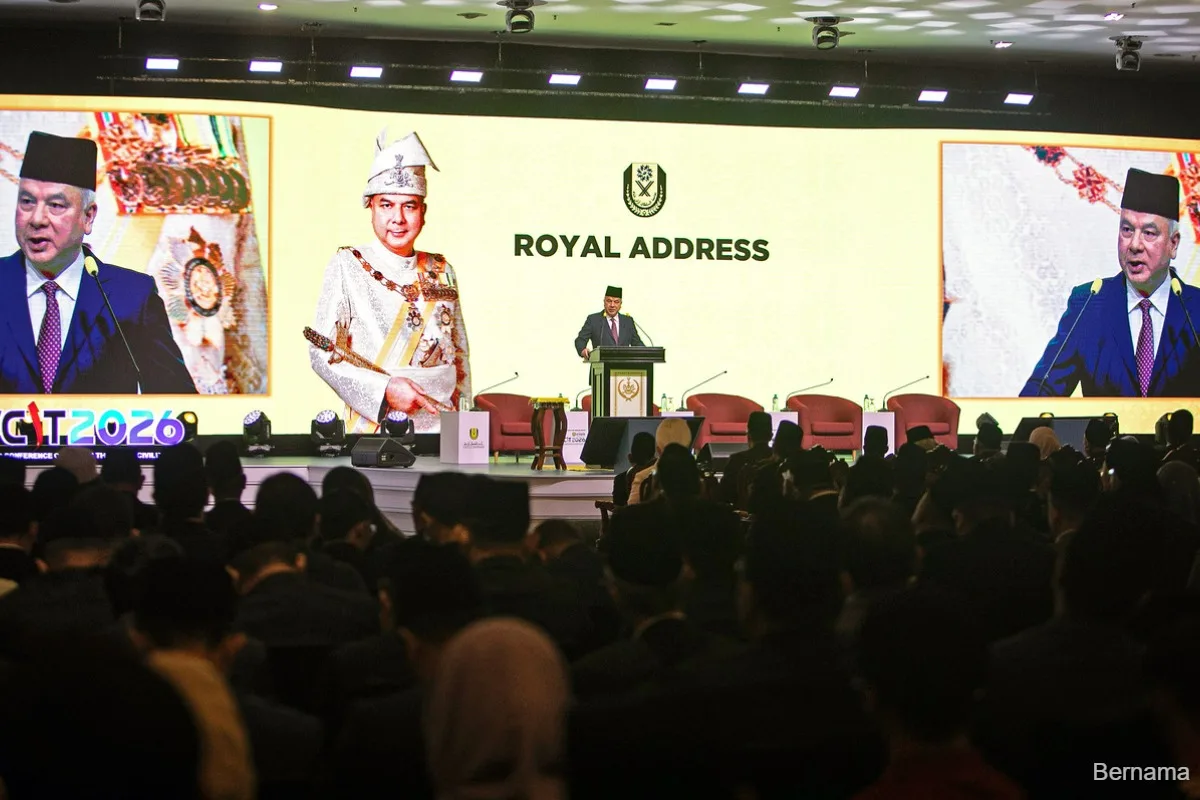
Sultan Nazrin Shah of Perak delivered the keynote address at the 8th World Conference on Islamic Thought and Civilisation on July 21, 2026, in Ipoh, Malaysia, stressing the importance of robust institutions and governance for national stability and prosperity [1, 2, 3, 4, 5, 6, 7, 8].
He warned that even a nation with abundant resources, talented people, and rich culture can fail if its institutions are weak and leadership lacks accountability. "Authority is not a privilege to be enjoyed; it is a trust to be discharged," he said, condemning the use of government machinery for personal or political gain as a betrayal of public trust [1, 3, 7, 8].
Good governance requires strong institutions able to survive beyond any leader's tenure. Transparency in managing public resources and fair application of the rule of law are essential, Sultan Nazrin added. Political stability should not mean suppressing disagreement but channeling it through legitimate institutions rather than violence. "Some of the most stable nations in the world are also among the most argumentative, precisely because their disagreements are channelled through legitimate institutions rather than through the street or the sword," he said [1, 3, 7, 8].
Highlighting the dangers of eroding institutional trust, he noted instability arises not from disagreement itself but from loss of confidence in elections, judiciary independence, and public office integrity. Vulnerable groups such as the poor and marginalized suffer most when trust breaks down [1, 3, 7, 8].
Sultan Nazrin emphasized national security must go beyond defending borders. "A country that is secure from external threats but riddled with internal corruption and injustice has not achieved true security at all; it has merely postponed its reckoning," he said. The most durable form of security is social cohesion, built on shared belonging and inclusion of all communities. He also warned against the manipulation of religion to justify division or exclusion, calling it a threat to national integrity [2, 4].
Education plays a vital role in fostering social mobility and unity, Sultan Nazrin stated. "Schools are often the first places where children from diverse backgrounds sit side by side, learn together and discover that difference need not mean distance." He called for curriculum reform to prepare youth for automation, climate change, and a knowledge-based economy while promoting honest history and multicultural understanding [6].
He also stressed governance must reflect moral values prioritizing all citizens' welfare, with a civil service serving irrespective of race, religion, or political affiliation. "A budget is a moral document as much as a financial one; it reveals, in the starkest possible terms, whose needs a government has chosen to prioritise," the Sultan noted [7, 8].
The conference continues to discuss the themes of unity and good governance amidst ongoing regional and national challenges[s1-s8].