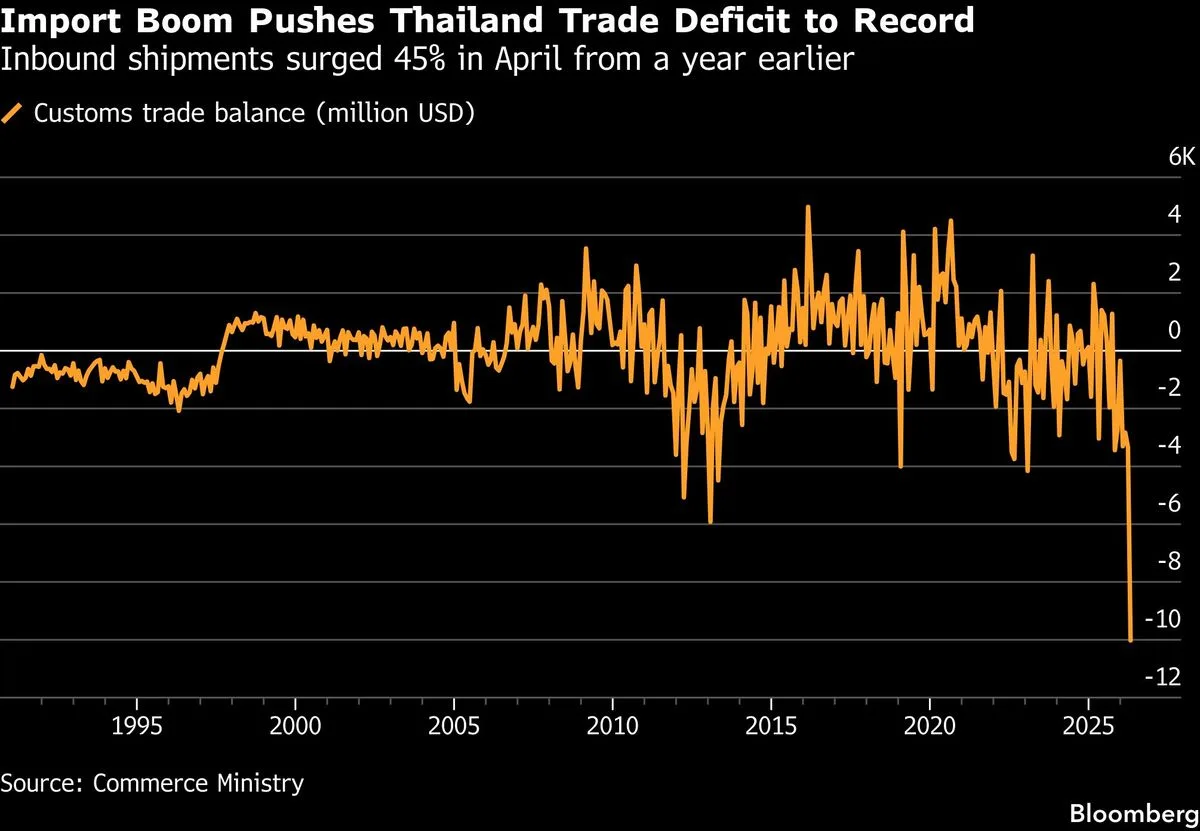
Thailand’s trade deficit widened to a record US$10 billion in April 2026, marking the largest shortfall since the country began tracking trade data in 1991 [1, 2]. The deficit expanded for the seventh consecutive month as imports surged 45% year-on-year, driven by higher purchases of capital goods, raw materials, and rising oil and gas prices [1, 2].
Exports also grew strongly, climbing 23.1% compared to April 2025, slightly surpassing median forecasts [1, 2]. However, the sharp increase in imports continues to outpace export gains, pushing the trade balance further into the red [1, 2].
The Commerce Ministry data released on May 25 confirmed these figures, showing rising import costs as the main factor behind the deficit’s expansion [1, 2]. Nantapong Chiralerspong from the Trade Policy and Strategy Office said, "The trend of strong imports and a widening trade deficit is likely to continue if energy prices remain elevated and the artificial intelligence boom continues to fuel trade flows, putting further pressure on the baht" [2].
Looking ahead, the Trade Policy and Strategy Office forecasts Thailand’s export growth for 2026 to range between a contraction of 3% and growth of 8%, with a baseline estimate of 3% growth [1, 2]. Persistent high energy prices and growing demand related to AI technologies could sustain strong import growth, maintaining pressure on the trade deficit and the Thai baht [1, 2].