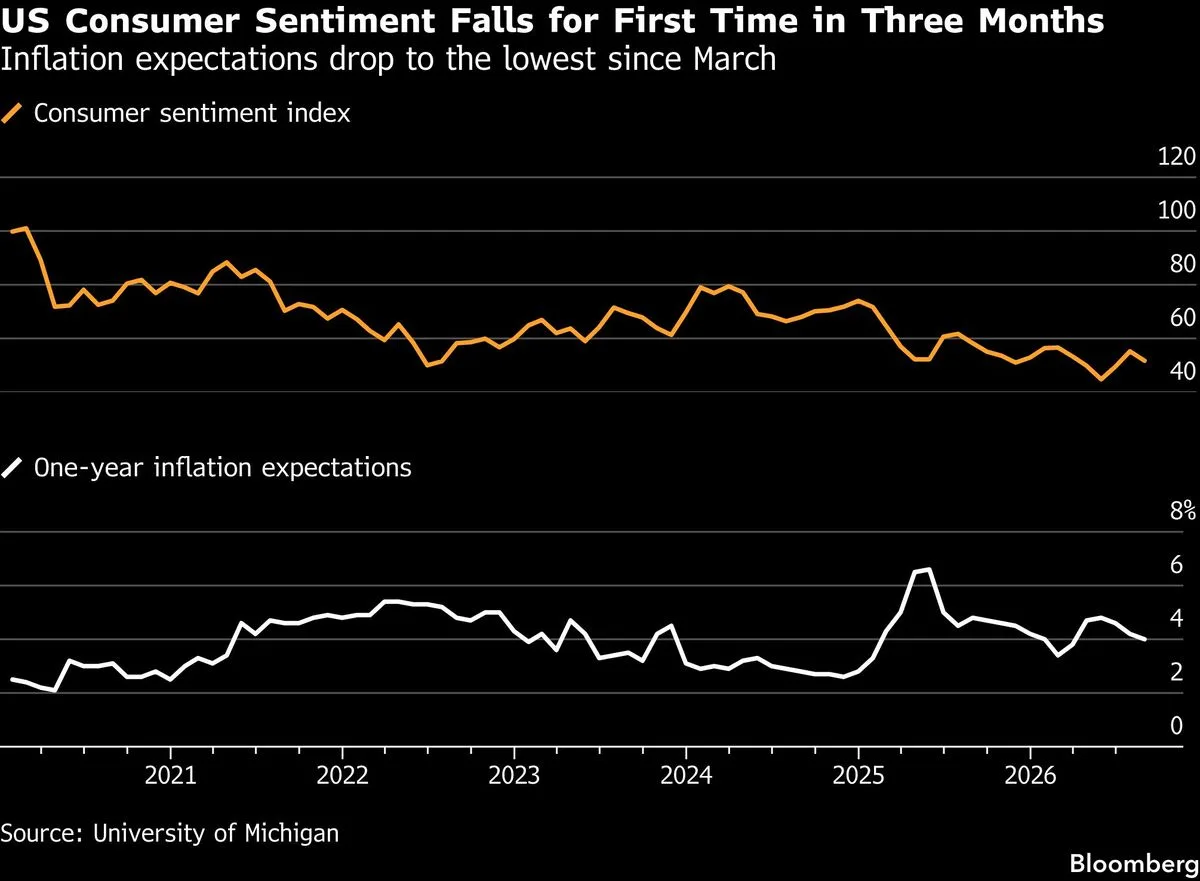
The University of Michigan's consumer sentiment index fell to 51.7 in August 2026, down 6% from 55.2 in July, according to data published today [1, 2, 3, 4, 5, 6]. This final reading was slightly higher than the preliminary figure of 51.0 released earlier [1, 2, 3, 4, 5, 6].
Consumers’ expectations for inflation over the next year eased marginally from 4.2% in July to 4.0% in August but remain historically high [1, 2, 3, 4, 5, 6]. The long-term inflation outlook, spanning five to ten years, stands at about 3.3% annually [1]. Joanne Hsu noted, "Consumers continue to worry that inflation will remain elevated for the foreseeable future" [1].
The August survey, conducted between July 28 and August 24, shows that ongoing geopolitical tensions, particularly the conflict in the Middle East, have pushed US inflation higher [1]. Gasoline prices have stayed above $4 per gallon throughout August. Hsu added, "在伊朗衝突等的政策不確定性持續存在下,消費者預期汽油價格無論短期或長期都將進一步上漲," highlighting expectations for further increases due to these uncertainties [2].
Sentiment dropped across political groups, with Republicans experiencing the steepest decline, reaching their lowest confidence level since November 2024 [1, 2, 3, 4, 5, 6]. Older consumers and those in middle-to-lower income brackets also showed sharper declines in confidence during August [2, 3, 4, 5, 6]. Joanne Hsu said, "消費者信心與本月初公布的初步數據一致,較上月下降約6%" [2].
The combination of persistent inflation concerns and geopolitical uncertainty has led consumers to adopt a more cautious outlook on the US economy [1, 2, 3, 4, 5, 6]. The University of Michigan will release its next consumer sentiment update next month, providing further insight into economic attitudes as conditions evolve.