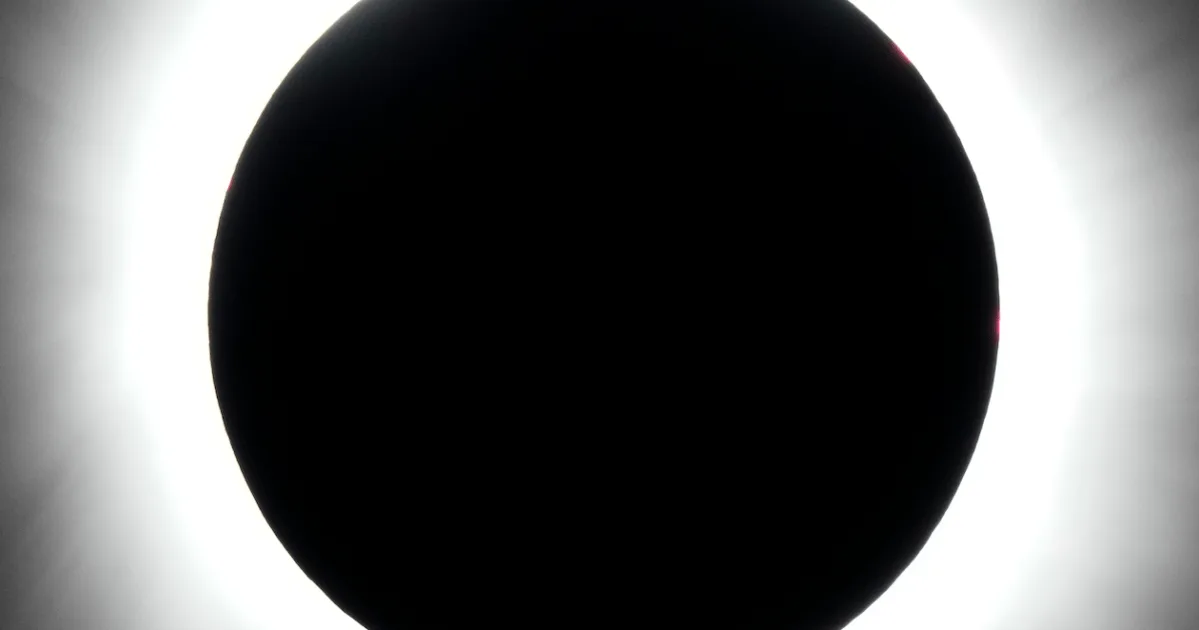
A rare total solar eclipse passed over parts of northern Russia, Greenland, Iceland, and Spain from August 12 to 13, 2026, marking the first total solar eclipse visible from mainland Europe since 2006 [1, 2, 3, 4, 5]. The path of totality began in Russia’s Arctic region at 17:00 GMT and crossed diagonally through Greenland and Iceland, including Reykjavik, which experienced its first total eclipse since 1433 [2, 3, 4, 5].
In Spain, the eclipse reached totality shortly before sunset around 18:30 GMT, lasting under two minutes as it crossed from the Atlantic coast through northern Spain to the Balearic Islands [2, 4, 5]. The lunar shadow raced across the Earth at about 3,430 kilometers per hour (2,130 mph), creating eerie twilight and a temperature drop of roughly 5 degrees Celsius (9 Fahrenheit) in affected Spanish areas [2, 5].
Millions gathered along the totality path, from Iceland to Spain, to witness the rare event. Special eclipse glasses sold out quickly in Spain as demand soared [1, 2, 3, 4]. Spanish authorities issued travel and traffic advisories for eclipse watchers and warned of wildfire risks amid dry summer conditions [5].
Scientists used the opportunity to deploy aircraft and ground observatories to study the Sun’s corona and magnetic activity during the eclipse [1, 4]. Observers described the event with awe. Isabel Troyano, a 56-year-old homemaker, said, "It’s a sight I never would have imagined seeing. I got goosebumps." Nanoscience researcher Alejandro Cuesta called it "the most beautiful thing I’ve seen in my entire life," adding, "I almost burst into tears. I got chills all over my body. It was magnificent." [2]
There is some debate over Spain’s last full total eclipse before 2026. Some sources state 1912 was the last, while others note astronomers regard a 1905 eclipse as the last full-scale total eclipse, with 1912 only a hybrid lasting a few seconds [2, 3, 5].
Beyond the path of totality, a partial eclipse was visible across much of Europe, parts of Canada, northern USA, and northwest Africa [2, 4, 5].
Spain begins a rare eclipse trilogy with another total and an annular eclipse expected in southern regions in August 2027 and January 2028 [5]. Meanwhile, the 2026 eclipse is forecast to bring a 347 million euro boost to Spain’s economy through tourism [4].