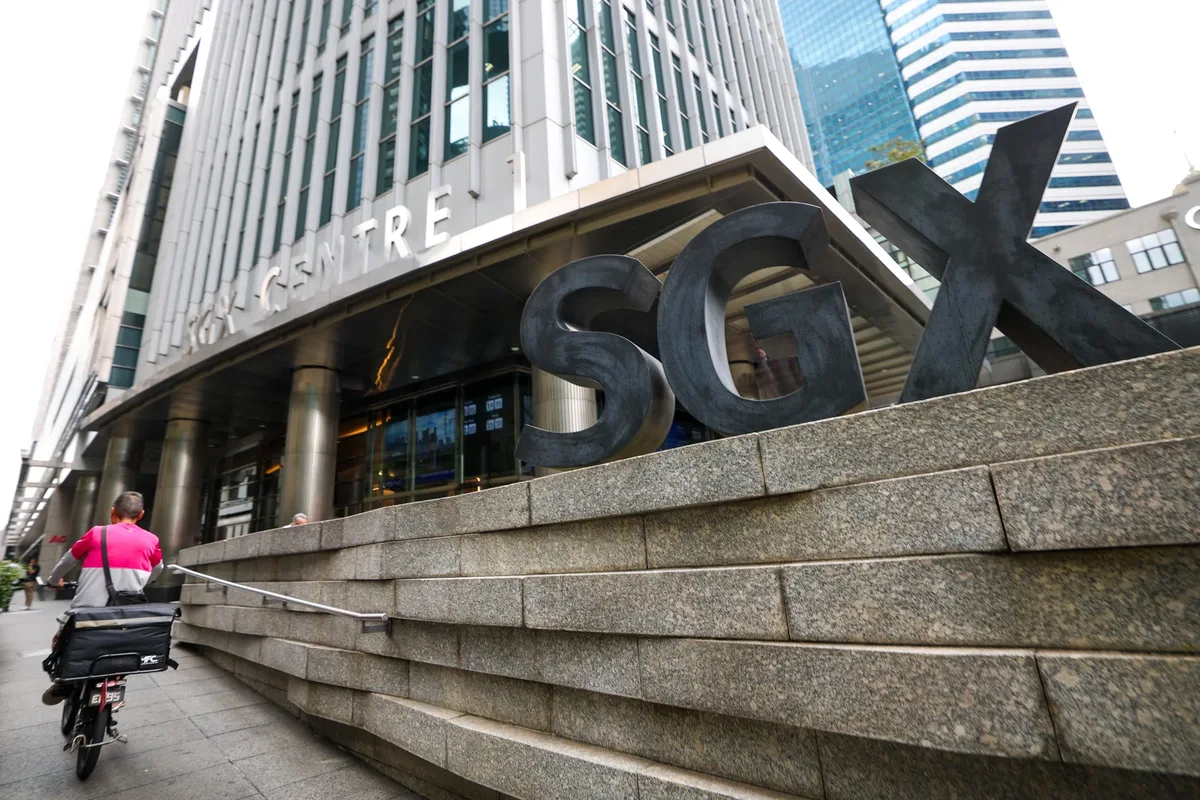
Singapore equities fell sharply on June 4, 2020, as renewed hostilities in the Middle East and fears of US Federal Reserve interest rate increases hit investor sentiment. The Straits Times Index (STI) declined between 1.0% in early trading to 1.4% at close, ending a two-day winning streak and finishing at 5,067.53 points [1, 2, 3].
DBS shares led the losses among local banks, dropping between 1.3% to 1.4%, wiping out around S$2.3 billion in market value with a share price fall of about S$0.81 to S$0.91 [1, 2, 3]. OCBC and UOB were also down by 2.2% and 1.3%, respectively [3]. Outside the banking sector, Yangzijiang Shipbuilding was the biggest decliner in the STI, falling 3.4%, while Mapletree Logistics Trust bucked the downtrend, gaining 0.8% [3].
The selloff was driven in part by escalating Middle East tensions. On June 3, Iranian attacks damaged Kuwait's airport and injured dozens, while US military strikes near the Strait of Hormuz pushed oil prices up about 2% [1, 2]. Lebanon and Israel agreed to a ceasefire that day, but fragile conditions kept regional risks elevated [1, 2]. These developments pressured oil prices and global markets, causing Wall Street stocks to retreat from record highs on June 3 amid inflation fears and rising crude [1, 2]. According to Jose Torres, senior economist at Interactive Brokers, investors responded by trimming equities across major US benchmarks despite some sectors gaining earlier in the day [3].
US interest rate policy added to the uncertainty. Federal Reserve Bank of Dallas president Lorie Logan said on June 4 that officials "may need to raise interest rates later this year to bring inflation to the 2 per cent target," signaling possible tightening ahead [1]. In contrast, Federal Reserve Bank of New York president John Williams said US monetary policy is "well positioned for now, with no obvious direction for the future path of interest rates" [1].
Regional markets mostly followed Singapore lower on June 4, including Japan’s Topix (-1.3%), Nikkei 225 (-1.8%), South Korea’s Kospi (-2.1%), Australia’s ASX (-1.3%), Hong Kong’s Hang Seng (-0.8%), and Shanghai’s CSI 300 (-0.4%) [1, 2, 3]. Malaysia’s FTSE Bursa Malaysia KLCI bucked the trend, rising 0.2% to 0.6% [1, 2, 3].
Political developments unfolded as well. On June 3, the US House voted to require President Donald Trump to withdraw US forces or obtain Congressional approval to continue fighting in the regional conflict [1, 2].
Singapore markets will watch closely for further geopolitical developments and Federal Reserve signals about interest rates in the coming weeks.