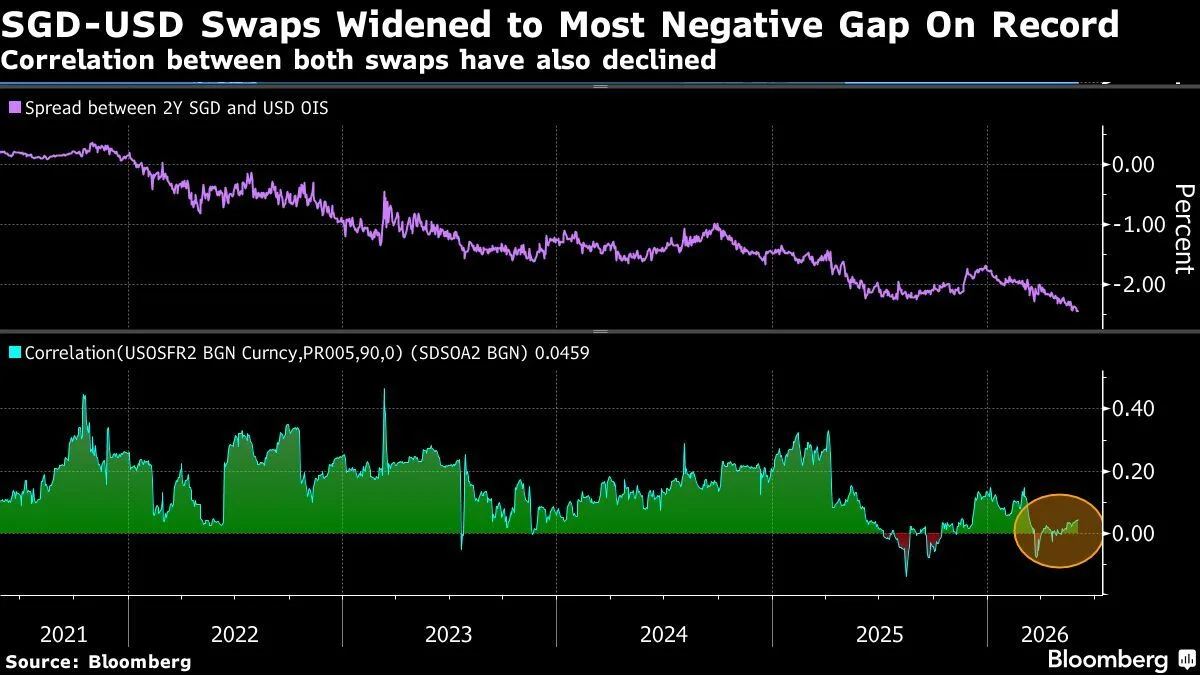
The two-year Singapore dollar swap rate traded at a discount of 246 basis points to its US counterpart this week, marking the deepest gap on record since data began in 2020 [1, 2]. This widening gap reflects ample liquidity in Singapore fueled by strong foreign capital inflows and rising borrowing costs in the United States due to inflationary pressures [1, 2].
Singapore's overnight interbank rate last week hit a near nine-month low and remains more than three percentage points below its peak in 2022, underlining the significant easing in local funding costs amid a flush liquidity environment [1, 2]. Emerging Asia strategist Galvin Chia at Societe Generale said, "We see this as a function of capital inflows and ample liquidity on the SGD side. Inflows to Singapore have kept liquidity conditions flush, translating into more resilient SGD rates despite rising global yields" [1].
The traditional close correlation between Singapore and US interest rates has weakened as Singapore's liquidity pool expands substantially, causing the swap spread between the two currencies to widen [1, 2]. Meanwhile, concerns about US inflation and energy prices are pushing the Federal Reserve towards further rate hikes, with markets currently pricing in an 80% chance of another quarter-point increase this year [1, 2].
Singapore's economy grew a robust 6% year on year in the first quarter of 2026, outpacing economists' consensus of 5.2% and signaling strong underlying momentum [1, 2]. However, the government maintains a more moderate GDP growth forecast for the full year at 2% to 4% [1, 2]. The city-state's stable political environment and resilient economy have drawn safe-haven demand amid geopolitical tensions in the Middle East, supporting bond markets and further bolstering capital inflows [1, 2].
Some analysts expect the Monetary Authority of Singapore to respond to these conditions by tightening monetary policy in July 2026 through appreciation of the Singapore dollar exchange rate [1, 2]. This potential move would seek to contain inflation and address the ongoing liquidity surplus.
The record swap rate gap between Singapore and the United States together with robust economic growth and anticipated policy tightening underline the complex interplay of global and local factors shaping interest rates and capital flows in Singapore as of mid-2026.