The U.S. military began a secret operation in early May 2026 to transfer oil covertly using ship-to-ship techniques near the Strait of Hormuz. The method employs aerial and water drones as well as helicopters to guide oil convoys to tankers off the coast of Fujairah, UAE, and Sohar, Oman, mirroring tactics long used by Iran to bypass sanctions [1, 2].
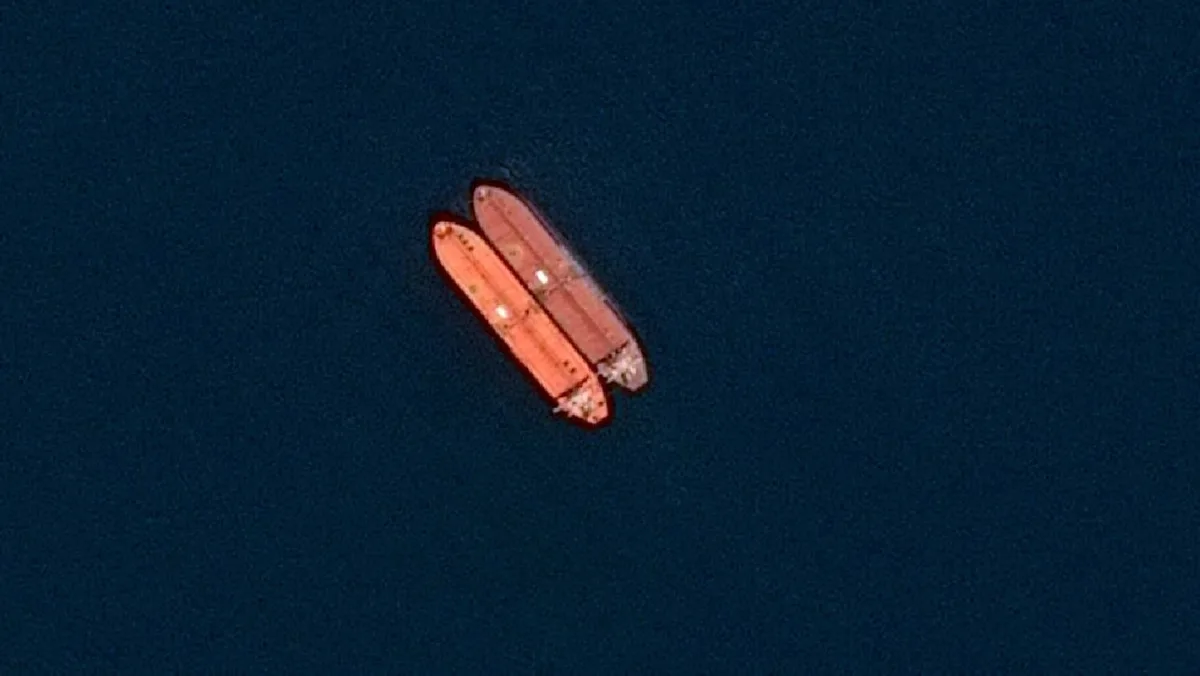
At least 92 ships have been reported involved in the transfers, according to one source, while another source indicates the number could be at least 116, highlighting some discrepancy in the total scale of the operation [1, 2]. Satellite images from June 11, 2026, revealed 17 pairs of ships actively conducting oil transfers simultaneously, marking a peak in activity [1, 2].
The operation uses shuttling techniques that have been previously employed by Iran to evade monitoring. The oil transfer sites lie near boundaries overseen by Iran’s Persian Gulf Strait Authority, which polices the Strait of Hormuz [1, 2]. Ships that fail to follow Iranian orders risk attacks from drones and missiles launched by the Iranian Revolutionary Guard Corps [1, 2].
Tensions escalated on June 9, 2026, when an Apache helicopter involved in the mission was shot down by Iranian forces. Both crew members were rescued by a drone boat. On that same day, observers noted six pairs of tanker ships clustered near the port of Sohar [1, 2]. The U.S. responded with retaliatory bombings following the attack on the helicopter [1, 2].
Iran has declined to comment on the U.S.-led oil transfer operation. Meanwhile, the Fujairah port, one of the key locations for the transfers, faced repeated attacks by Iranian fire during the timeframe of the operation [1, 2]. U.S. defense officials have denied that forces from Central Command are directly participating in the transfers [1, 2].
The use of drones and helicopters illustrates a sophisticated logistical effort to move oil covertly through one of the world’s most strategically sensitive maritime chokepoints.
The operation remains active as of early September 2026, with no public indication of an imminent conclusion [1, 2].