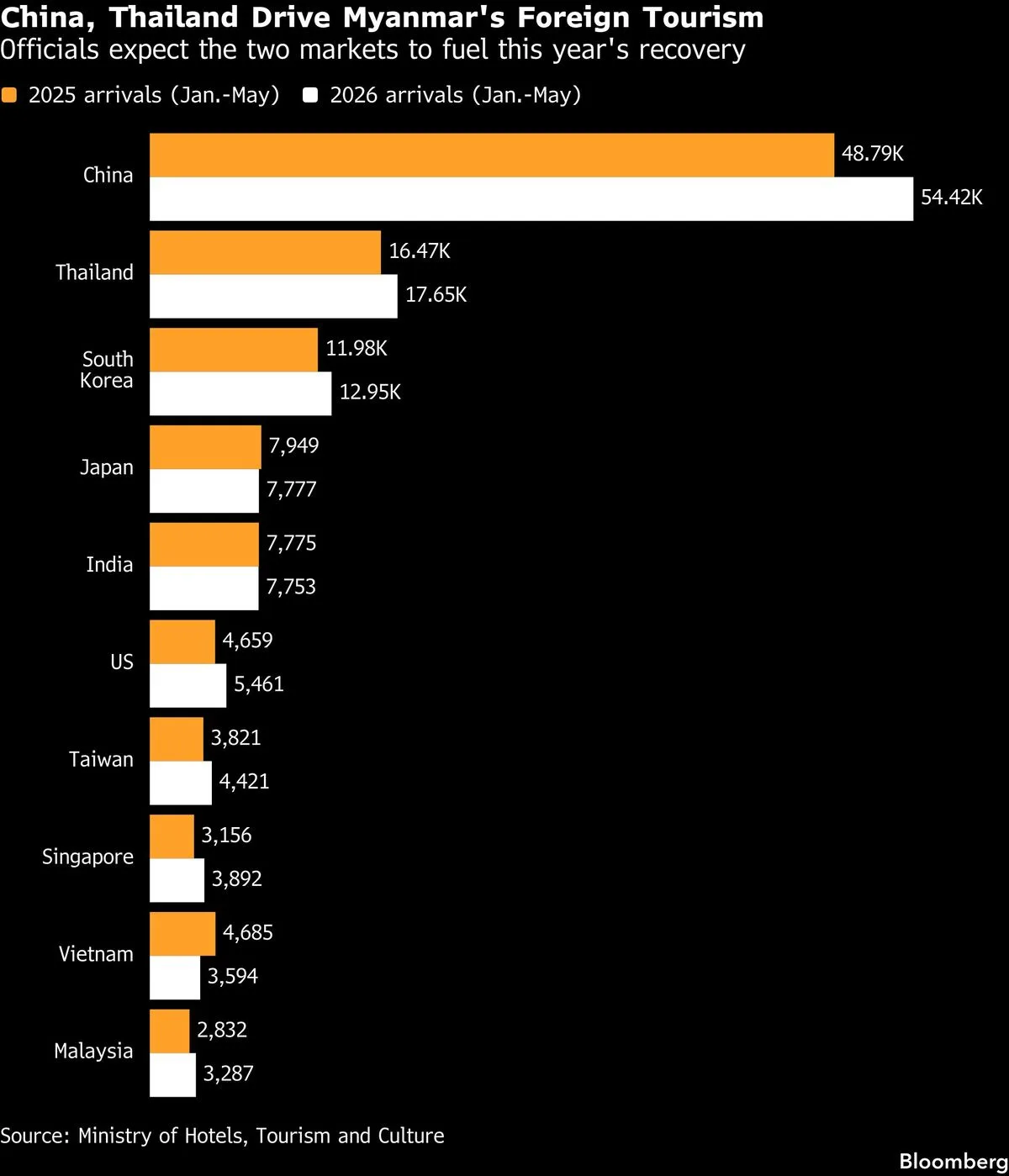
Myanmar’s government is aiming to attract 1.8 million foreign tourists in 2026, almost doubling last year’s arrivals, by easing visa restrictions and promoting its ancient temples as tourist attractions [1, 2, 3, 4]. The target compares to 973,263 international visitors in 2025, with 448,205 arrivals recorded through May 2026, a 5% increase from the same period in 2025 [1, 2, 4].
Chinese tourists remain the largest group arriving by air, followed by visitors from Thailand and South Korea. Chinese arrivals rose 12% in the first five months of 2026, while Thai arrivals grew 7%, fueling optimism for further tourism growth [1, 2, 4]. Maung Maung Kyaw, permanent secretary at Myanmar's Ministry of Hotels, Tourism and Culture, said, "We mainly expect to see a surge in Chinese and Thai visitors, so they will be a key driver of our tourism growth" [1, 2, 5, 4].
Myanmar has expanded its visa-on-arrival program to travelers from China, India, Japan, and South Korea. Meanwhile, Russia and most Southeast Asian countries already enjoy visa-free entry, encouraging more legal arrivals [1, 2, 4].
However, official data does not account for victims trafficked into scam compounds, an issue that has prompted crackdowns and repatriation of thousands of Chinese nationals [1, 2, 4]. The tourism industry was severely damaged by the 2021 military coup and ongoing civil conflict, which has caused over 100,000 deaths, according to conflict data [1, 2, 5, 3, 4].
Despite ambitions, the government’s 1.8 million target remains far below the pre-crisis peak of roughly 4.7 million visitors in 2015 [1, 2, 4]. For comparison, Thailand attracted about 33 million tourists in 2025 and aims for similar numbers in 2026, far outpacing Myanmar [1, 2, 4].
Tourists from China accounted for 35% of inbound visitors in 2024, followed by Thailand at 15%, underscoring the importance of these markets for Myanmar’s tourism recovery [5].
Myanmar’s tourism recovery will depend on the government’s ability to maintain eased visa policies and promote cultural attractions successfully. The industry will continue tracking arrivals throughout 2026 to assess progress toward the 1.8 million target [1, 2, 3, 4].