Preschool teacher Yusmarni Mohammad Hasni suffered chronic shoulder instability for 12 years after a judo injury during secondary school, experiencing frequent dislocations. She described how her shoulder would dislocate even when holding onto a bus handle, severely affecting her daily life [1]. In May 2025, Yusmarni had a severe shoulder dislocation accompanied by sharp pain that led her to seek treatment at Khoo Teck Puat Hospital (KTPH) in Singapore [1, 2, 3].
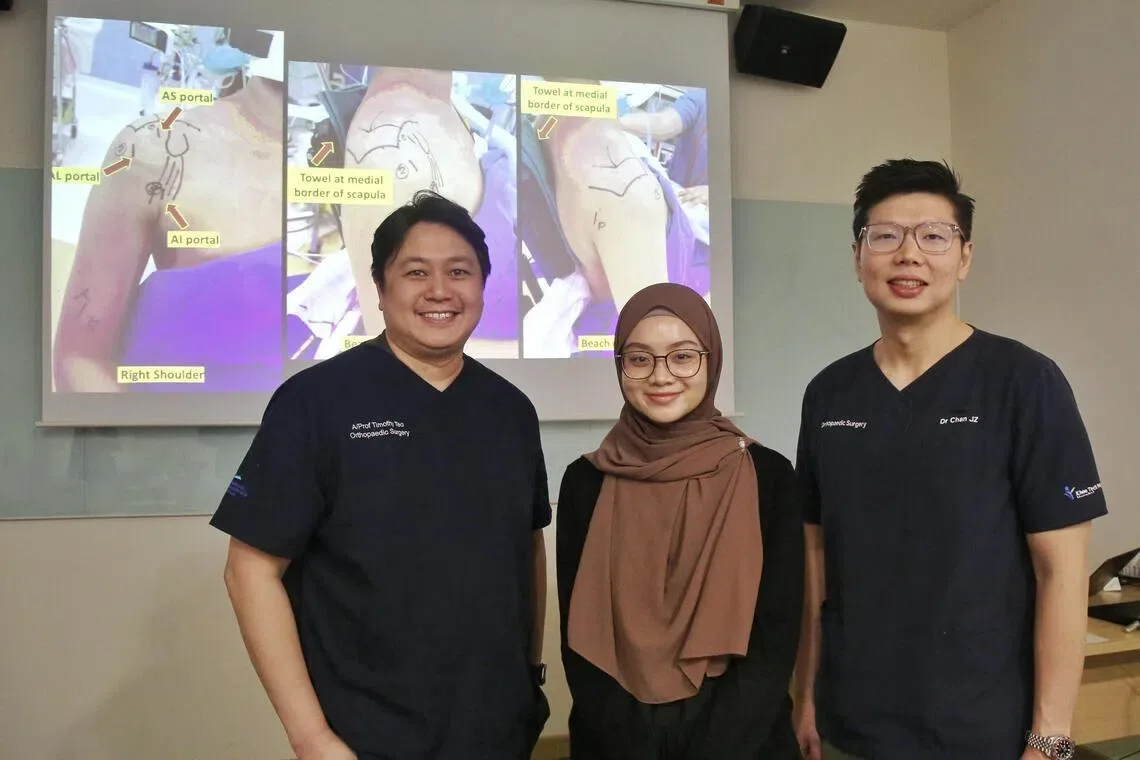
Orthopaedic surgeons at KTPH developed a new keyhole surgery technique to stabilise shoulders and prevent future dislocations [1, 2, 3]. Yusmarni became the first patient in Singapore to undergo the procedure in August 2025 [1, 2, 3]. The surgery involves making three small incisions, each 1 to 2 cm long, at the front of the shoulder—fewer incisions than the usual five or six used in conventional keyhole shoulder surgeries [1, 2, 3].
The procedure is guided by an arthroscope, which allows surgeons to see the joint clearly and avoid damaging critical nerve areas [1, 2, 3]. During the operation, surgeons transfer part of the shoulder blade bone to the damaged socket area to address bone loss caused by repeated dislocations [1, 2, 3].
Keyhole surgery for shoulder instability has been used since the 2000s but remains complex and not widely practiced. Consultant surgeon Chan Juen Zhik noted, "Even for us who do arthroscopic surgery almost day in and day out, the learning curve for this kind of procedure is still very steep," which motivated the team to develop a simpler and safer approach [2]. He said, "I wanted to make it both simpler and safe."
Compared to open surgery, the keyhole approach results in smaller scars and less pain during recovery [1, 2, 3]. Yusmarni recalled her injury experience, saying, "I tried to sit up, but I couldn’t. I was crying, it was my most painful experience yet" [1].
Yusmarni was 27 years old at the time of surgery [1, 2, 3]. The hospital plans to continue refining this technique and offer it to more patients with frequent shoulder dislocations.