Singapore has introduced a new legal requirement for coastal landowners to build defenses against rising sea levels. Starting in 2028, all landowners with at least 30 years left on their lease along the coast must have plans to construct protection measures capable of handling a 2.15-meter sea level rise by the year 2150, based on worst-case greenhouse gas emissions scenarios [1, 2, 3, 4].
For coastal landowners whose leases have less than 30 years remaining, preparations should consider a lower sea level rise of 0.7 meters by 2050, according to a worst-case ice melt scenario. However, this latter scenario is considered unlikely [1, 2, 3, 4].
The Singapore government owns about 70% of the coastal land and will take responsibility for defending most of the coastline. The remaining 30% is privately owned non-residential land, mainly comprising shipyards, ports, oil and gas facilities, and manufacturing areas along the southwest and northern coasts, including Jurong Island and industrial estates at Tuas, Pioneer, and Senoko [1, 2, 3, 4].
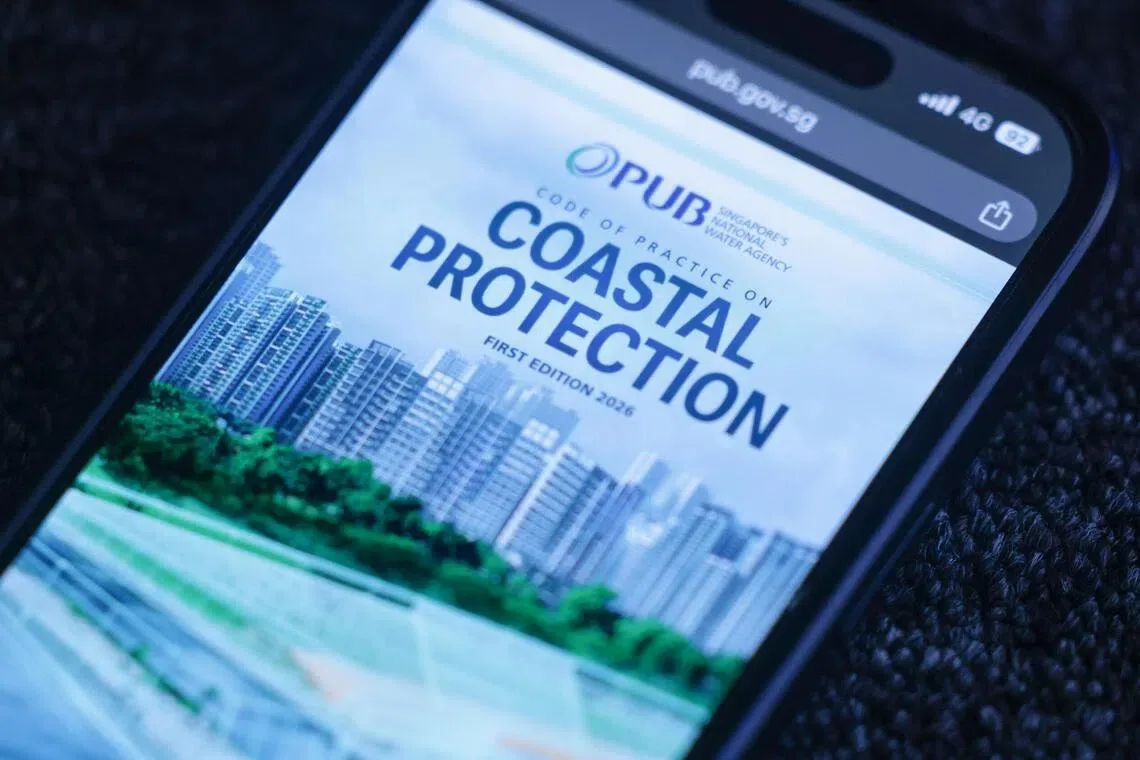
The new Code of Practice on Coastal Protection, released on June 17, 2026, sets out detailed guidance for the design, maintenance, inspection, and management of coastal defensive structures. It also includes provisions for emergency drills in temporarily floodable public spaces like beaches and parks. The code aims to help waterfront leaseholders meet the requirements of the new law mandating occupants to build and maintain continuous coastal defenses [1, 2, 3, 4].
Failure to comply with the requirements—either by not building or by disrupting a continuous coastal barrier—could lead to fines and imprisonment [1, 2, 3, 4].
Minister for Sustainability and the Environment Grace Fu said the Code offers “greater clarity on what good coastal protection looks like — and how to deliver it well.” She added that the guidelines would be updated over time to reflect new scientific findings and technological advances related to sea level rise and coastal defenses [1].
The government clarified that the 2.15-meter and 0.7-meter figures relate to projections under extreme scenarios and do not mean seawalls or protections will be exactly those heights [1, 2, 3, 4].
The Code of Practice took effect on June 17, 2026, with full implementation starting in 2028 when landowners with longer-term leases must have their protection plans ready [1, 2, 3, 4].