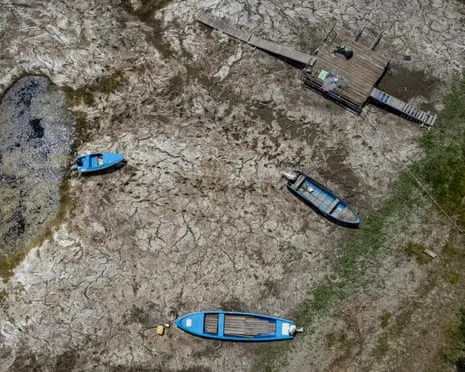
Western Europe experienced its hottest June and July on record in 2026, with a combined average temperature of 21.62°C, surpassing the previous record set in 2022 [1, 2, 3, 4]. Persistent high-pressure systems trapped warm air over the region, causing the third and fourth heatwaves since May [1, 2, 3, 4]. Samantha Burgess of the European Centre for Medium-Range Weather Forecasts said, "July 2026 was the third consecutive month of exceptional heat in Western Europe," and explained that dry soils lost their natural cooling ability, allowing heat to build more rapidly [3].
Severe drought conditions have emerged, with soil moisture levels significantly below those seen in July 2022, reinforcing the heat and drought feedback loop [1, 2, 3, 4, 5, 6, 7]. Key rivers including the Seine, Rhine, and Danube hit unusually low water levels, disrupting transport, irrigation, and energy supply [1, 8, 2, 3, 6, 7, 4]. More than half a dozen European nuclear plants have shut down or reduced output due to cooling water shortages [9, 8, 10]. The low river levels have severely limited shipping on the Rhine and Danube, with economic losses estimated at 0.3 percentage points of GDP in Germany from halted Rhine shipping [9, 10].
France and Spain suffered their worst wildfires in living memory during the summer of 2026. In late July, a megafire burned nearly 42,000 hectares in France’s Gironde department, forcing over 220,000 people to evacuate [3]. Spain’s largest recent wildfire scorched almost 44,000 hectares near Madrid in Ávila province [3]. The wildfire season in Europe is on track to be the largest ever recorded [9, 11, 10].
Spain tied its record for the hottest month in July, averaging 25.7°C, 2.6°C above the 1991-2020 norm. Northern regions experienced unprecedented heat anomalies, including a record 44.2°C in Murcia on July 23 [12]. Eastern and northern Europe, including Scandinavia, were cooler than average, making July the 11th warmest month for all of Europe [2, 12].
Economic impacts are severe, with disruptions to power production, shipping, agriculture, and public health estimated to cost hundreds of billions of euros [9, 11, 10]. Agricultural yields have declined, with maize and sunflower crops down 6-7% as of July [9, 10]. Heatwaves have caused tens of thousands of deaths, including over 10,000 heat-related fatalities in Germany alone [9, 10]. Economist Sehrish Usman noted, "there are multiple episodes of extreme events... mostly in the same regions, compounding their impact." Southern Europe is also seeing tourism declines and rising food price inflation, complicating central bank policy [10].
Global ocean temperatures hit record highs for the second or third consecutive month in July 2026, with an average sea surface temperature of 20.96°C. The marine heatwaves around Europe and a strong developing El Niño in the Pacific are key drivers. Copernicus director Carlo Buontempo said, "We are now facing a very large El Nino – possibly unprecedented in terms of amplitude." Ocean warming continues to worsen storms, rainfall patterns, and coral bleaching [1, 5, 3, 6, 7, 4].
Scientists predict 2026 or early 2027 will be the warmest year on record globally [6, 7].
The next major seasonal update on Europe's climate situation is expected as autumn approaches, with experts monitoring how the drought and heatwaves evolve into the cooler months.