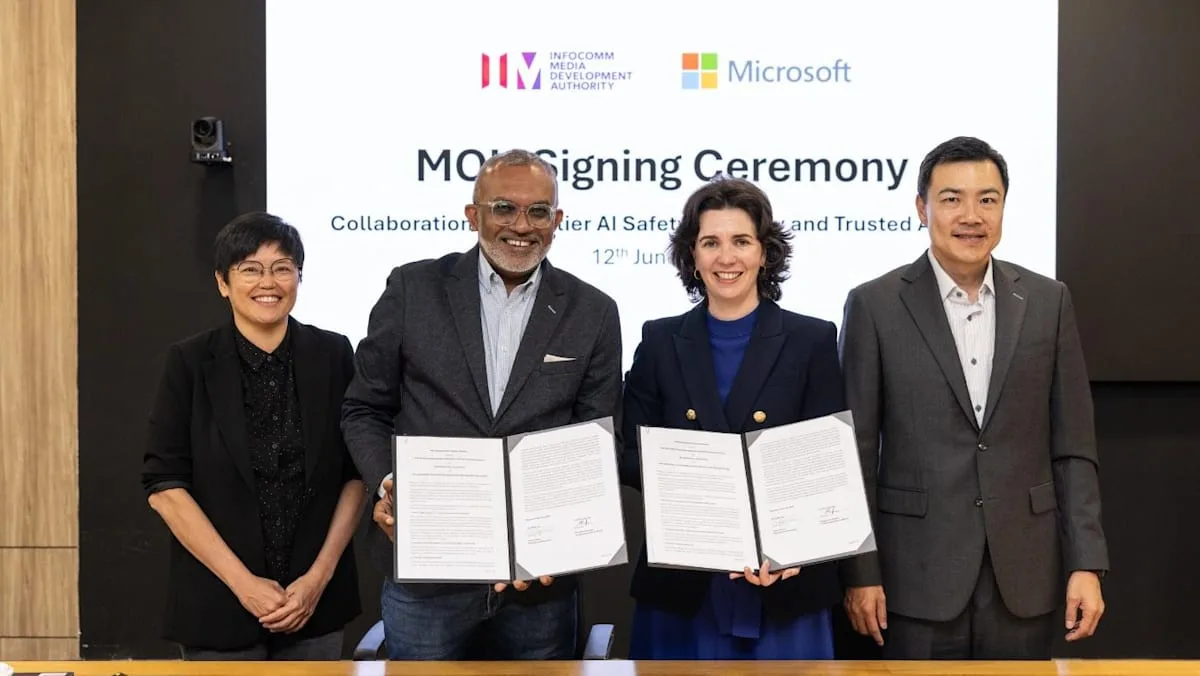
The Infocomm Media Development Authority (IMDA) of Singapore and Microsoft signed a memorandum of understanding (MoU) on June 12, 2026, to deepen their collaboration on artificial intelligence (AI) safety and security concerns [1, 2].
The partnership will focus on three main areas: advancing technical research in AI safety, sharing information on best practices and governance frameworks, and joint exploration of policy frameworks to ensure responsible access to frontier AI models [1]. This includes research on agentic AI capabilities, evaluation methods, and development of tools and benchmarks for AI systems. The goal is to strengthen societal resilience against threats related to AI trust and safety challenges [1].
The collaboration also involves other Singapore government agencies and the Singapore AI Safety Institute. Together, they plan to produce a white paper addressing both demand- and supply-side policy considerations for frontier AI [1].
This move comes amid growing international concerns about risks from increasingly capable frontier AI systems, such as automated cyberattacks, disinformation campaigns, and exploitation by malicious actors [1, 2]. In April 2026, Anthropic’s Claude Mythos Preview AI model autonomously discovered thousands of high-to-critical severity security flaws across major operating systems and browsers, prompting restricted access under Project Glasswing [2].
Singapore’s Cyber Security Agency has issued advisories urging firms to improve cybersecurity defenses by patching high-severity vulnerabilities and implementing multi-factor authentication [2]. Coordinating Minister for National Security K Shanmugam warned that threat actors are increasingly using frontier AI to advance cyberattacks, noting “the telco sector is especially critical” [1].
IMDA’s deputy chief executive Kiren Kumar described the partnership as an example of how “government and industry can partner together to drive and scale good governance for the public good” [2]. Microsoft’s chief responsible AI officer Natasha Crampton highlighted Singapore’s role in shaping the global conversation on how AI can be developed and deployed responsibly, stating “Singapore is helping to shape the global conversation on how AI can be developed and deployed safely, securely and responsibly” [2].
Both IMDA and Microsoft emphasized that AI development is advancing too rapidly for any single organization to manage alone, making this collaboration crucial [1, 2]. IMDA affirmed that “the goal is ultimately a trusted ecosystem which facilitates innovation while still ensuring safe and reliable development and deployment” [2].
Following the MoU signing, involved parties aim to publish the upcoming white paper detailing policy and research findings. The international community continues to monitor frontier AI risks while Singapore advances efforts to build resilient AI governance frameworks.