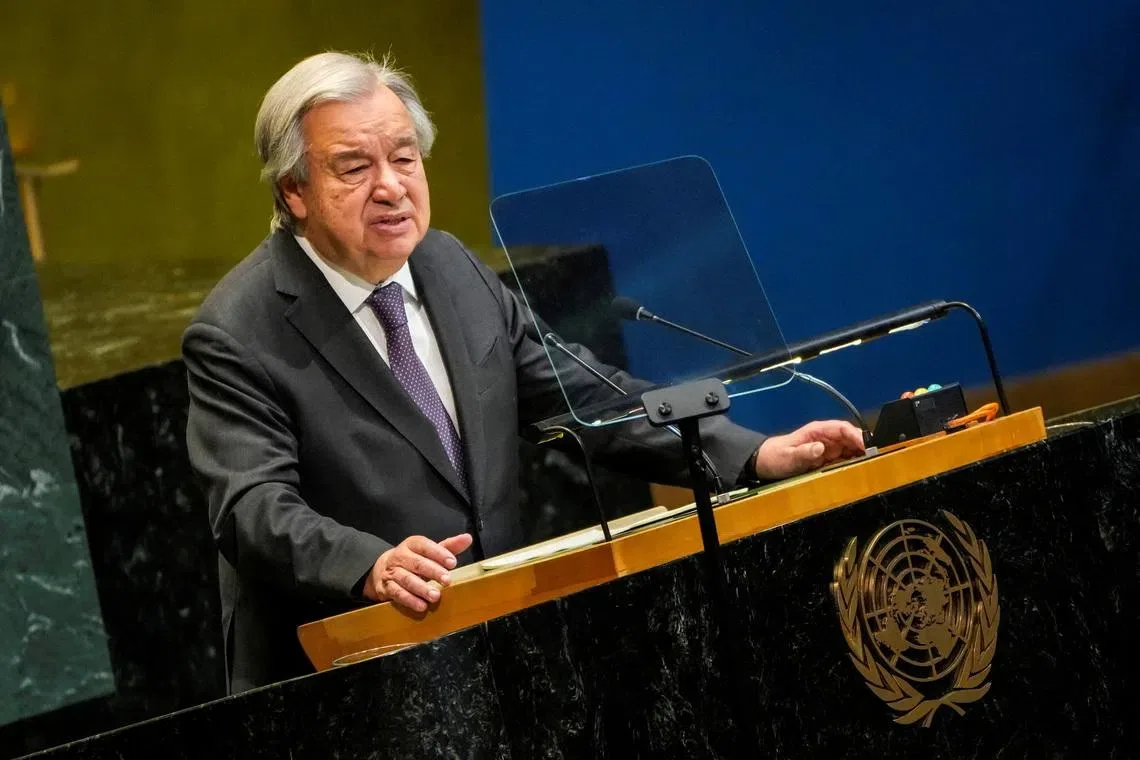
UN Secretary-General Antonio Guterres warned on July 6, 2026, at the first-ever Global Dialogue on AI Governance in Geneva that artificial intelligence is advancing faster than regulatory measures can keep pace, urging globally harmonized rules to reduce risks, especially to children [1, 2, 3, 4, 5, 6].
Over 4,000 representatives from governments, technology companies, academia, and civil society gathered July 6-7 to discuss setting international standards for AI development and deployment [1, 2, 4, 5, 6]. Guterres emphasized that innovation must have guardrails. "Any child must not become an unregulated AI 'test subject'... We never let children use drugs before proving safety. We test every toy," he said [2]. He called for AI governance to prioritize safety, particularly for children, and human accountability in AI systems [1, 2, 3, 4, 5, 6].
Guterres warned against allowing AI to autonomously write code or decide humanity’s future through what he called "vibe coding" or natural language commands, describing the practice as unsustainable and risky [3, 4, 5, 6]. He voiced concern over AI power and capabilities being concentrated in a few large tech companies and countries, leaving many nations without influence over critical decisions affecting their futures [2, 3, 4, 5, 6].
Highlighting the dangers posed by AI to children, the UN is pushing the "AI Child Safety Pledge" which requires AI systems to be tested and independently supervised before deployment with zero tolerance for AI-generated child sexual abuse material—99% of which currently involves deepfakes of a sexual nature, predominantly targeting women and girls [2].
Guterres also called for transparency from AI firms regarding their ecological impact, urging that all data centers supporting AI run on renewable energy by 2030 [2, 5]. He criticized the minimal public funding for AI capacity building in developing countries compared with private investments, noting more than 20 countries support a UN-backed global network focused on building AI capacity worldwide [2].
Addressing militarization risks, Guterres condemned autonomous lethal weapons systems, or "killer robots," saying, "Killer robots – machines choosing targets and taking lives without human control and judgment — have no morality, they are truly repugnant... We need international law to comprehensively ban them" [3, 4, 5, 6].
He concluded the dialogue with a call to action: "We may be the last generation that can decide how humans and machines can coexist. The door remains open but will not stay open forever" [5]. German Foreign Minister Annalena Baerbock stressed the importance of ensuring AI funds benefit all countries fairly [4].
The second UN Global Dialogue on AI Governance is scheduled for May 2027 in New York, aiming to continue international efforts to set effective AI rules and safeguards [1, 2, 4, 6].