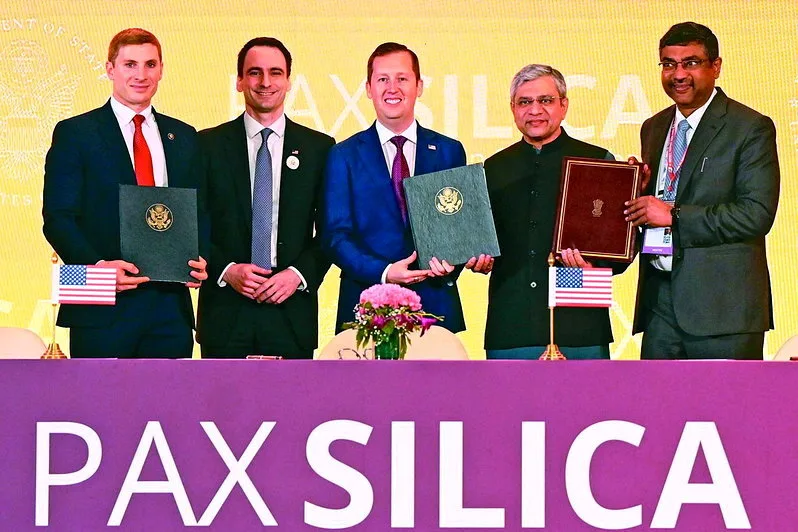
The US is drafting a letter to 35 countries that signed the June 2026 AI Opportunity Statement, urging them to choose between the US-led Pax Silica initiative and China's World Artificial Intelligence Cooperation Organization (WAICO) and warning against joining both due to conflicting commitments [1, 2]. The letter stresses that "signature of the Pax Silica Declaration is not merely a membership subscription, but a commitment," adding that "it cannot be held alongside membership in duplicative initiatives whose expectations conflict with our own" [1]. An anonymous US official said, "Fish and bear’s paw cannot both be had. It is difficult to imagine a country claiming to be a trustworthy partner in one ecosystem while joining a competing China-led AI initiative" [3].
The US launched the Pax Silica initiative in 2025 to secure supply chains for AI models, semiconductors, and critical minerals amid growing technology rivalry with China [1, 2, 3, 4, 5, 6]. About two dozen countries, including Japan, Australia, South Korea, and Kazakhstan, have joined Pax Silica[s1–s6]. In July 2026, China launched WAICO to promote open-weight AI technology as a direct challenge to US influence[s1–s6]. WAICO currently includes 29 countries, with Kazakhstan notably the only country participating in both WAICO and Pax Silica[s2–s6].
US officials are concerned about Kazakhstan’s dual membership and the broader risk of countries splitting allegiances in the escalating AI competition[s1–s6]. The US aims to cut off China’s access to critical resources and limit its ability to develop advanced AI technologies with potential military or economic uses[s1–s6]. A draft letter seen by Reuters on August 14 made clear that "to be part of everything is to be part of nothing" and countries must commit fully to either the US or China-led coalition [1]. The State Department has not confirmed when or if the letter will be formally sent and declined comment on the leaked document[s1–s6].
China has condemned US demands as politicizing trade and technology, with a Chinese embassy spokesperson warning that "such actions will only stifle global AI advances and serve no one’s interests" [1, 5, 6]. Kazakhstan’s embassy in Washington has not commented on its membership in both initiatives [1, 3, 5, 6].
The AI Opportunity Statement was signed by 35 countries in June 2026, signaling their intent to cooperate with Washington on AI issues[s1–s6]. The next concrete step depends on when the US State Department decides to officially send the letter to these countries, potentially forcing them to publicly declare loyalty in the intensifying AI geopolitical contest.