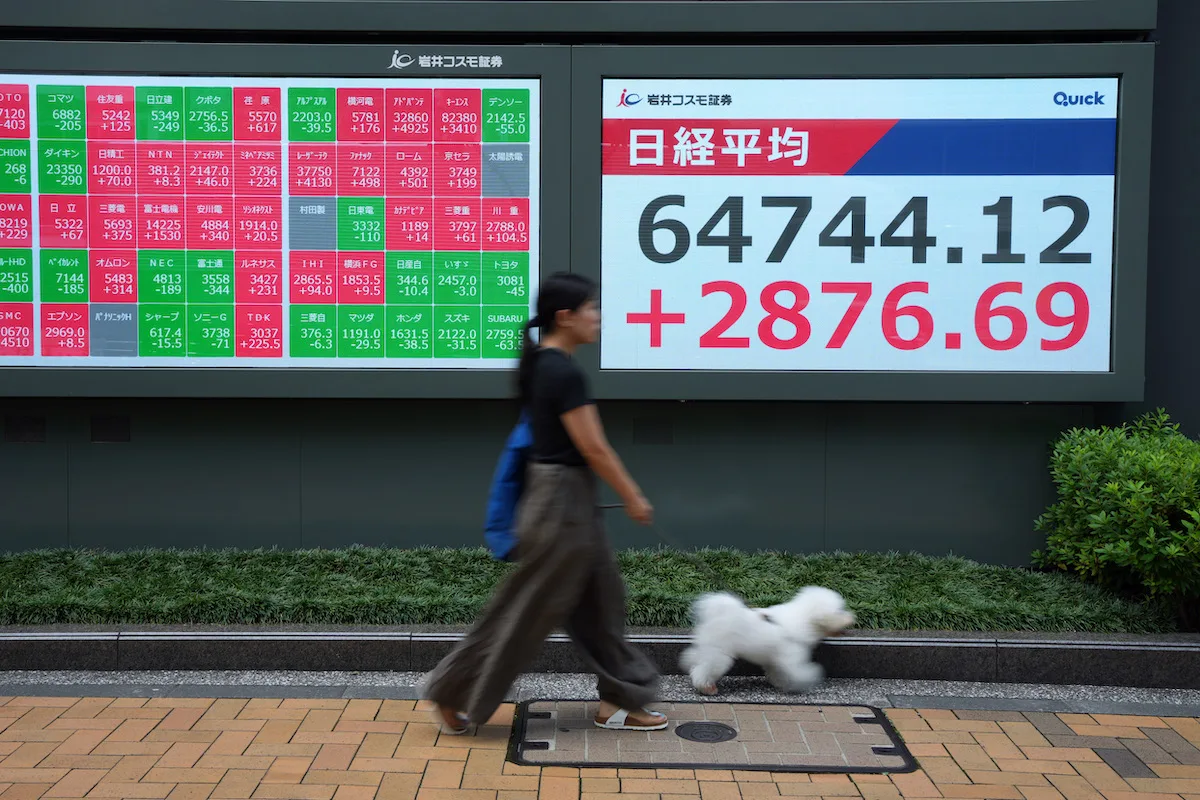
Asian stock markets rose on August 13-14 after US consumer prices increased moderately in July, easing fears of an immediate Federal Reserve interest rate hike [1, 2, 3, 4, 5]. US consumer prices rose 0.2% month-on-month and 2.5% annually, marking the slowest inflation pace since March 2021 [1, 2, 3, 4]. The data helped push South Korea's Kospi Index up 3.7%, entering a technical bull market driven by gains in AI-related technology shares [4]. Japan's Topix index was up 0.5% to 0.8%, while Australia’s S&P/ASX 200 and Hong Kong's Hang Seng saw mixed or slight declines [3, 4].
Short-dated US Treasury yields rose as markets priced less than a 50% chance of a Fed increase in September, though probabilities for hikes in October and December rose to 54% and 92% respectively [1, 2, 3, 4, 5]. The Federal Reserve is now seen as likely to keep policy rates unchanged in September [5]. Cleveland Fed President Beth Hammack said"Rate hikes are needed to bring down persistently high inflation" despite recent inflation easing [5].
US technology sector AI stock gains bolstered markets despite company-specific earnings setbacks. Notably, Nasdaq 100 futures slipped early in Asian trading following disappointing earnings from Cisco and sales declines at Cerebras Systems [1, 2, 3, 4]. Cisco shares fell between 4.1% and 8.4%, with some sources calling the earnings unimpressive and shares down 8.4% despite beating estimates [s1-s5].
Brent crude fell below $88 per barrel and West Texas Intermediate dropped under $83 after several days of rallying, affected by ongoing Middle East conflict risks creating volatility in oil prices [s1-s5]. US 10-year Treasury yields recently hit highs not seen since 2007 at bond auctions [1]. The Japanese yen traded close to 160 per US dollar, raising speculation about possible official intervention in forex markets [s1-s4].
Gary Schlossberg of Wells Fargo Investment Institute said, "The CPI reading and a cooler-than-expected jobs report may keep hawkish Fed officials at bay in September. However, we remain guarded on the near-term outlook for inflation amid volatile oil prices tied to the ongoing Middle East conflict along with lingering core price pressures from a strong economy and the AI boom." [1]
Arun Sai from Pictet Asset Management noted, "We are in the early innings of the capex buildout. We have digested a fair bit of uncertainty in the AI ecosystem." [4]
The US consumer price index data for July was released on August 12, showing 0.2% monthly and 2.5% annual increases, setting off the rally in Asian markets through August 13 [1, 2, 3, 4]. South Korea's Kospi surged into a bull market and Brent and WTI crude prices declined after multi-day rallies on August 13 [1, 3, 4]. By August 14, markets shifted Fed rate hike expectations significantly, reducing September odds but increasing chances later in the year [5].