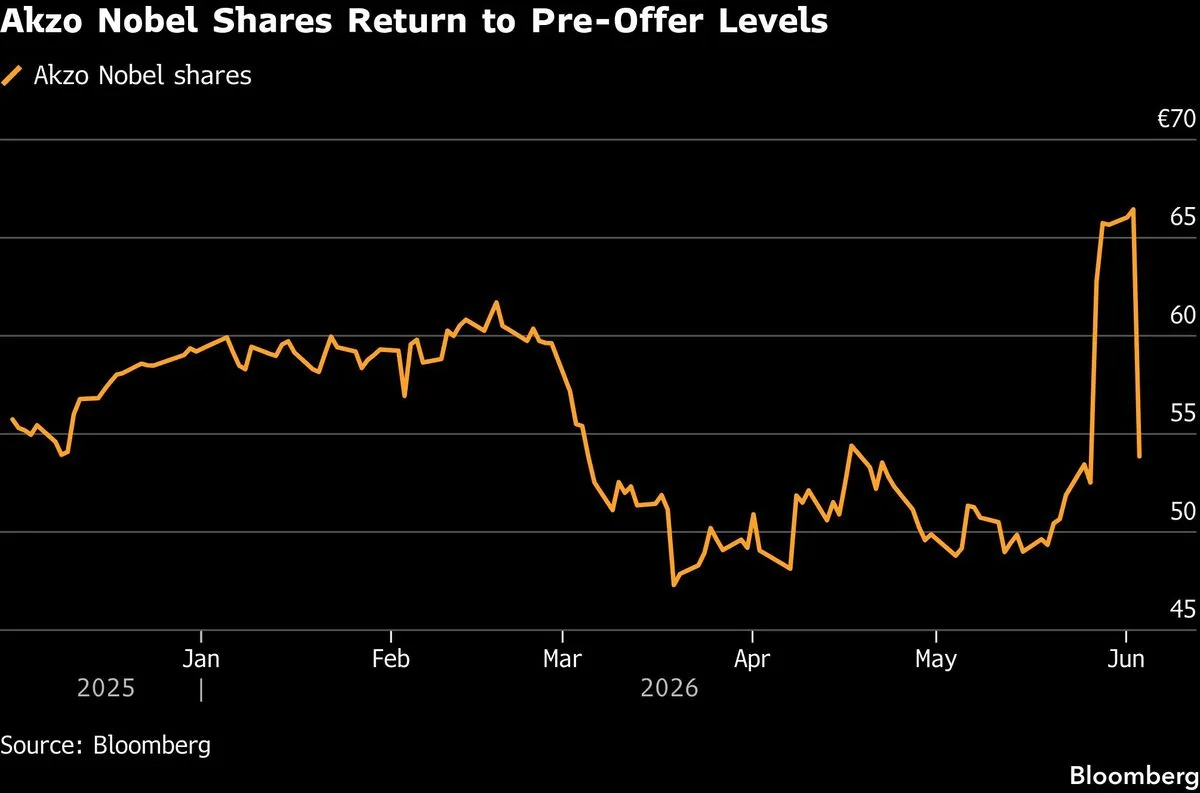
Nippon Paint Holdings Co. and Sherwin-Williams Co. ended their effort to buy Dutch paintmaker Akzo Nobel NV on June 3, citing regulatory hurdles that made approval unlikely, according to sources [1, 2]. Akzo Nobel rejected two joint all-cash offers from the pair, including the most recent bid of €73 per share, valuing the company at €12.5 billion ($14.5 billion) [1, 2]. Following the announcement, Akzo Nobel shares plunged as much as 22%, marking the largest one-day drop in the company’s history [2].
Akzo Nobel previously announced in November 2025 a planned merger with U.S.-based Axalta Coating Systems Ltd., a deal which its board unanimously supports [2]. The merger would create a paint company with an estimated enterprise value of about $25 billion, with Akzo Nobel holding a 55% stake in the combined entity [2]. Akzo Nobel also plans to move its share listing to New York after around 30 years on the Amsterdam exchange [2].
The Axalta merger requires regulatory approval from the U.S. Federal Trade Commission, which in May 2026 requested additional information for its review [2]. Akzo Nobel cited difficulty in obtaining regulator approval as a key reason for rejecting the Nippon-Sherwin proposal [2].
Global paintmakers face challenges from sluggish demand and rising raw material costs linked to Middle East conflicts. Akzo Nobel has been raising prices to offset higher input costs, such as titanium oxide, and has implemented restructuring measures including site closures and job cuts [2].
Nippon Paint had previously disrupted merger talks between Axalta and Akzo Nobel in 2017 and failed in efforts to acquire Axalta. That same year, Akzo Nobel rejected a $29 billion takeover offer from PPG Industries [2]. Activist investor Cevian Capital, which holds about a 10% stake in Akzo Nobel, backs the Axalta deal. Cevian partner Robert Schuchna sits on Akzo Nobel’s board, which unanimously rejected the Nippon-Sherwin offer [2].
The next key step is awaiting final U.S. regulatory approval for the Axalta-Akzo Nobel merger, as the FTC’s additional information request signals ongoing scrutiny that could determine the merger's timeline [2].