Japan and the United States conducted coordinated currency market intervention on July 31 to buy Japanese yen and strengthen its value against the US dollar, the first such joint effort since 2011 [1, 2].
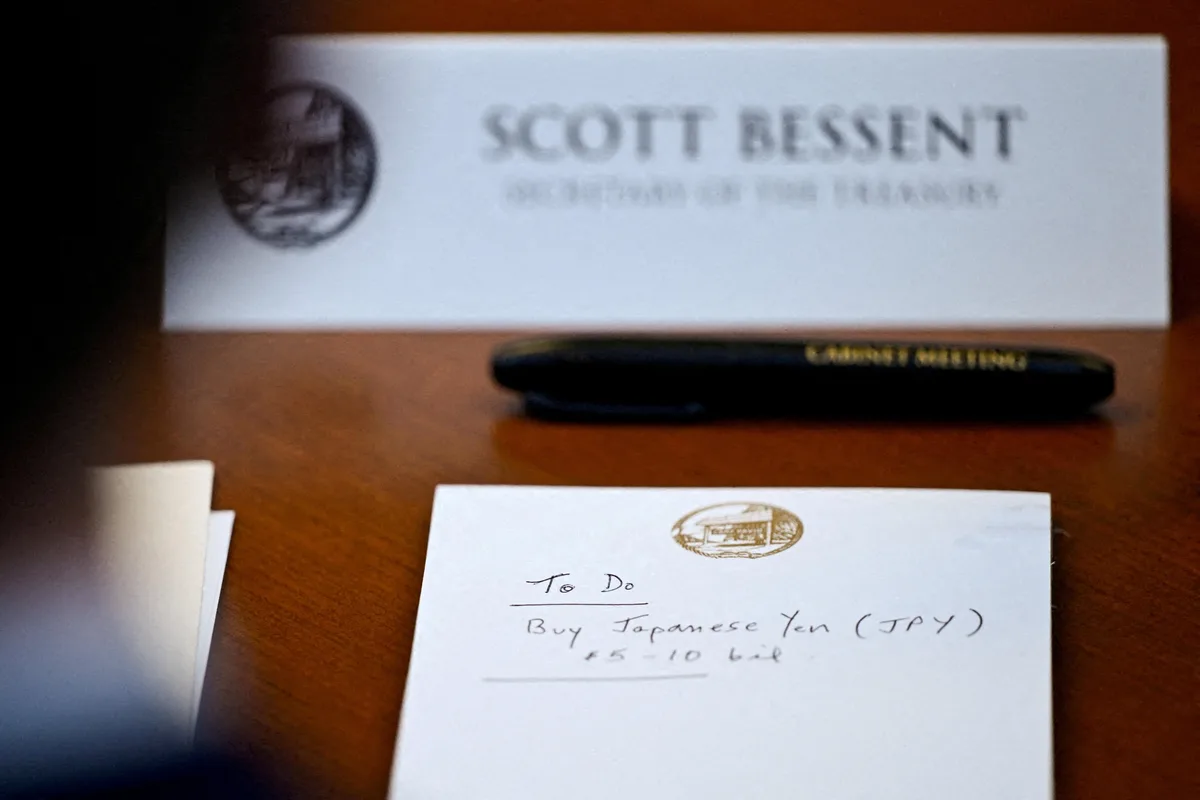
Japan reportedly spent about $31.8 billion buying yen during the intervention, based on preliminary Bank of Japan data, while the US Treasury took part by selling euros to purchase yen [3, 4]. US Treasury Secretary Scott Bessent was seen at a Camp David cabinet meeting the same day with a “to do” list item planning to buy $5 to $10 billion worth of yen [5, 2].
The coordinated action came after the yen hit historic lows near 164 yen per dollar in late July. Following the intervention, the yen strengthened to around 157–158 per dollar by early August, partially reversing years of decline [6, 2]. President Donald Trump described the US participation as "a signal of friendship" with Japan and to support the global economy, saying, "They wanted a little bit of help, and we're always there for Japan... More than anything else, it was a signal of friendship" [7].
Secretary Bessent reaffirmed US commitment to yen stability on August 4, stating, "We will do whatever it takes to support them in a way that helps the American economy, the American taxpayer." He warned that the yen's undervaluation risked broader economic fallout [4, 8]. He also noted, "The market had underestimated the authorities. It has likely become more difficult for speculators to sell the yen. If there is another intervention, the dollar-yen exchange rate will likely fall below 155 yen" [2].
Despite the initial gains, the yen surrendered nearly half its post-intervention advance by August 7, trading at about 158.4 yen per dollar and fueling speculation of further interventions [6, 9]. Currency strategists caution that the intervention may offer only temporary relief amid Japan’s loose fiscal and monetary policies. Moh Siong Sim, an OCBC strategist, said, "The possibility of another round of intervention is high especially as dollar-yen approaches 160. But for intervention to be effective, it needs to be accompanied by faster BOJ rate hikes or a backdrop favouring Federal Reserve easing" [9].
The Bank of Japan kept its benchmark interest rate unchanged in late July, though markets expect a possible rate hike in September to support the yen [6, 9]. Traders remain cautious about the intervention’s durability, expecting yen trading to hold roughly between 155 and 160 in the near term [8, 6].