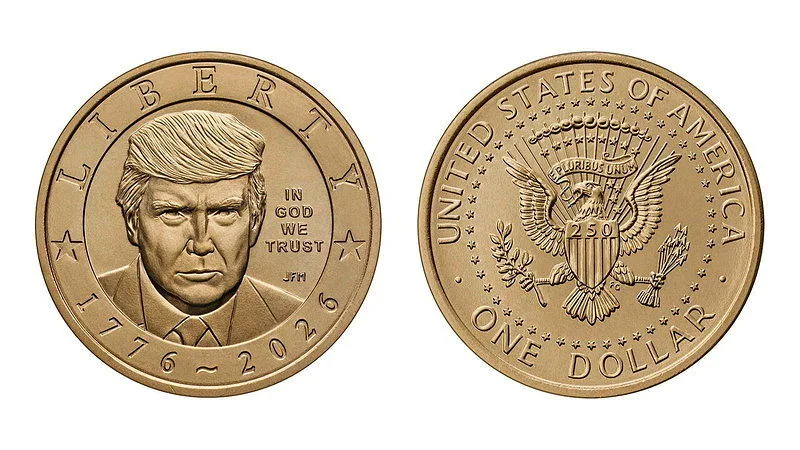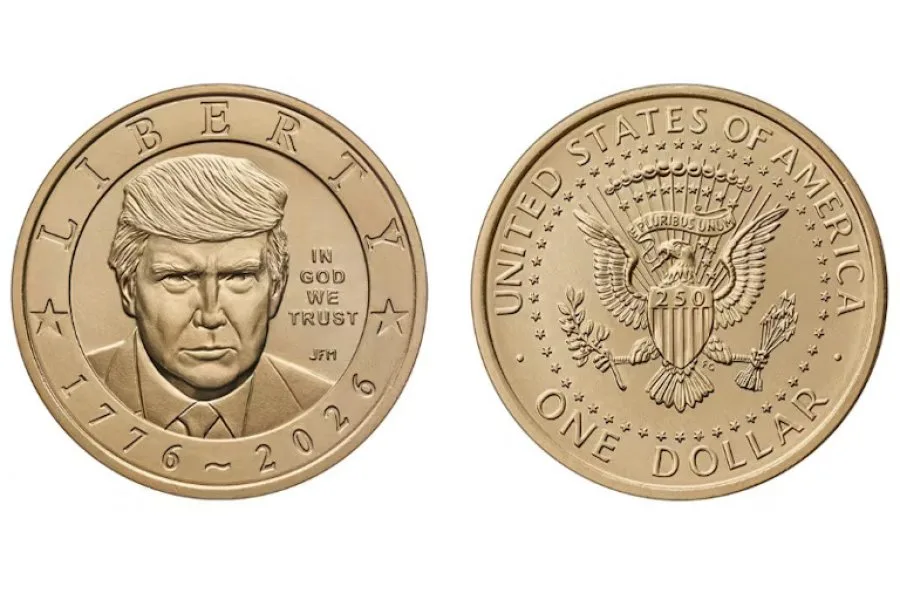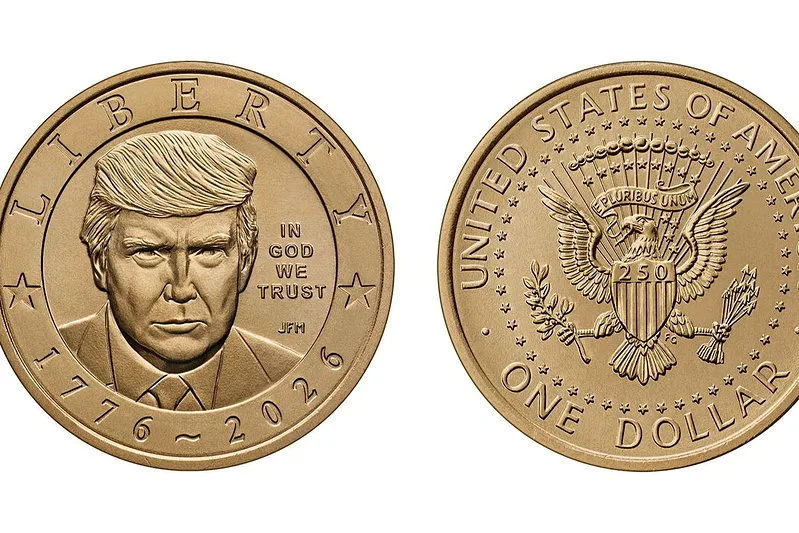
The US Mint launched a $1 coin featuring President Donald Trump's portrait on September 2, 2026, at noon Eastern Time through its website [1, 2, 3, 4, 5, 6, 7]. The coins commemorate the 250th anniversary of US independence and are legal tender with a face value of $1 [1, 8, 5, 9, 6, 7]. Collectors can purchase the coins in rolls of 25 priced at $61 or bags of 100 priced at $154.50 [s1–s10].
The coin’s obverse design was created by US Mint chief engraver Joseph Menna based on an official White House photo by Daniel Torok [1, 2, 3, 4, 5, 6]. The reverse features a variation of the US presidential seal with an eagle clutching arrows and olive branches and a shield marked "250" for 250 years [8, 5, 9, 6]. Approximately 9 million coins will be minted and released into circulation [6]. Despite the gold-colored appearance, the coins contain no actual gold and consist mostly of copper with zinc, manganese, and nickel [1, 5, 9, 6].
A special "July 4" mark appears on about 250,000 coins minted at the Philadelphia Mint on July 4, which are randomly mixed into rolls and bags as a collector's surprise [s1–s4,s8,s9]. The launch caused heavy traffic on the US Mint website, which implemented a wait queue with about a one-hour estimated wait time shortly after noon [s1–s4,s10]. Inventory of the coins sold out within hours, with 100-coin bags showing out of stock by the afternoon [5].
Donald Trump becomes the first living US president to appear on circulating US currency in about 100 years, the last being Calvin Coolidge on a 1926 commemorative half dollar [s1–s4,s6,s8,s9]. The issuance has sparked legal and ethical controversy. Critics say it violates federal laws and traditions forbidding living persons on currency to avoid politicization. Democratic Senator Chris Van Hollen said, "Putting a living President's portrait on US currency violates the tradition intended to avoid politics influencing the currency and uphold institutional integrity" [8, 10, 9, 7]. However, the Treasury Department and US Mint point to the 2020 Circulating Collectible Coin Redesign Act, which authorizes the 2026 redesigns for the US 250th anniversary, citing the 1926 Coolidge coin as precedent [9, 6]. The coin’s obverse bears Trump’s portrait, while the reverse avoids depiction of living persons, skirting some prohibitions [9, 6]. The US Treasury stated the coins "also will enter circulation" and that the program "is authorized under legislation celebrating the 250th anniversary of American independence" [8].
The US Mint encourages the public to check their change for the new coins, which have already begun entering general circulation [s1–s4,s8]. It attributes the pricing to production costs, collectible packaging, distribution, and collector demand, consistent with other collector coins [7]. The Treasury Department and US Mint are continuing to ramp up production following the initial sellout.