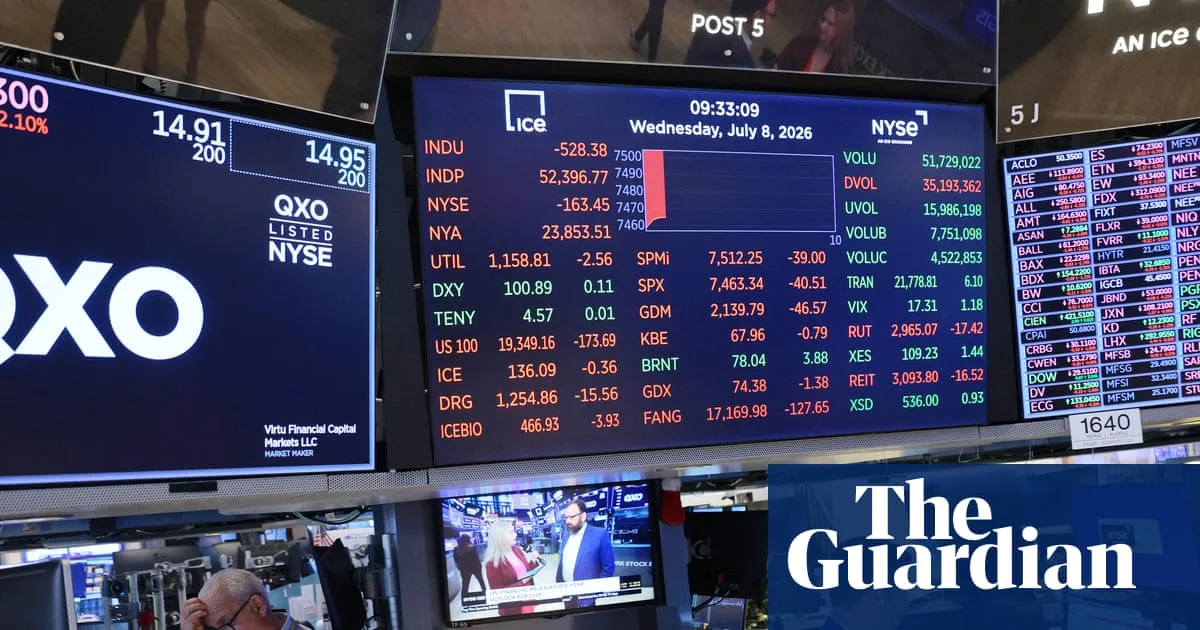
Wall Street chip stocks declined sharply on July 7 as investors questioned the sustainability of the AI rally despite Samsung Electronics reporting a 19-fold jump in second-quarter operating profit [1, 2, 3]. The S&P 500 slipped about 0.3% to 0.45% around 7,512 points, and the Nasdaq dropped between 0.62% and 1.16%, depending on sources, to a range near 25,818–25,960 points amid losses in major chip makers including Intel, which fell about 8%, and Micron, which declined between 4.7% and 7.3% [1, 2, 4]. The Philadelphia Semiconductor Index plunged 4.5% to 5.5%, hitting a four-week low [1, 2, 3].
Market watchers pointed to concerns about the AI sector’s overvaluation and the next phase of equity gains requiring broader market leadership. UBS’s Ulrik Hoffmann-Burchardi said the growth story remained attractive but warned the next leg "is likely to be marked by a broadening of market leadership" [3]. Morningstar’s Michael Field commented Samsung’s strong results were met with investor caution, explaining that negativity around Samsung spread across markets [1]. Horizon Investments’ Zachary Hill added, "Expectations have gotten to be almost impossible to beat for these companies" [2].
Contributing to the jitters were reports that Chinese startup DeepSeek is developing its own AI chip, raising concerns about competition and reduced reliance on Nvidia and Huawei chips [1, 2, 4]. Meanwhile, geopolitical tensions escalated after former US President Donald Trump's July 8 statement ending the interim Iran ceasefire and warning of further strikes, pushing Brent crude oil prices above $80 per barrel, a more than 5% jump, and causing additional stock market pressure [5, 6, 7]. US inflation remained elevated at 4.2% in May 2026, with the Federal Reserve indicating potential rate hikes later in the year [5].
Despite these headwinds, optimism in chip stocks returned following SK Hynix’s highly anticipated Nasdaq debut on July 9–10. The South Korean memory chip maker raised about $26.5 billion through its IPO priced at $149 per ADR, the largest US IPO by a foreign company, and saw shares surge more than 13-14% above the offering price [8, 9, 10, 11, 7]. The advance contributed to a chip stock rally that helped the Nasdaq and S&P 500 close higher [10, 11]. Micron Technology also announced plans to invest over $250 billion in US chip production through 2035 to meet AI-driven demand [8, 9, 12, 10].
The chip rebound continued July 10 when the Nasdaq 100 rose 1.7%, and the Philadelphia Semiconductor Index climbed 4.5% despite ongoing Middle East tensions and volatile oil prices [12, 10, 11]. By July 11, US stocks ended higher with AI enthusiasm prevailing over geopolitical worries as markets awaited the start of Q2 earnings season [7]. Meta Platforms signaled plans to produce its own AI chips starting in September, adding to the sector’s innovation pipeline [8, 9].
The market now watches Q2 earnings results closely. Ameriprise’s Anthony Saglimbene noted companies "will need to do more than just beat estimates," needing to prove margins hold at high levels and guidance improves to sustain tech-led growth [12].