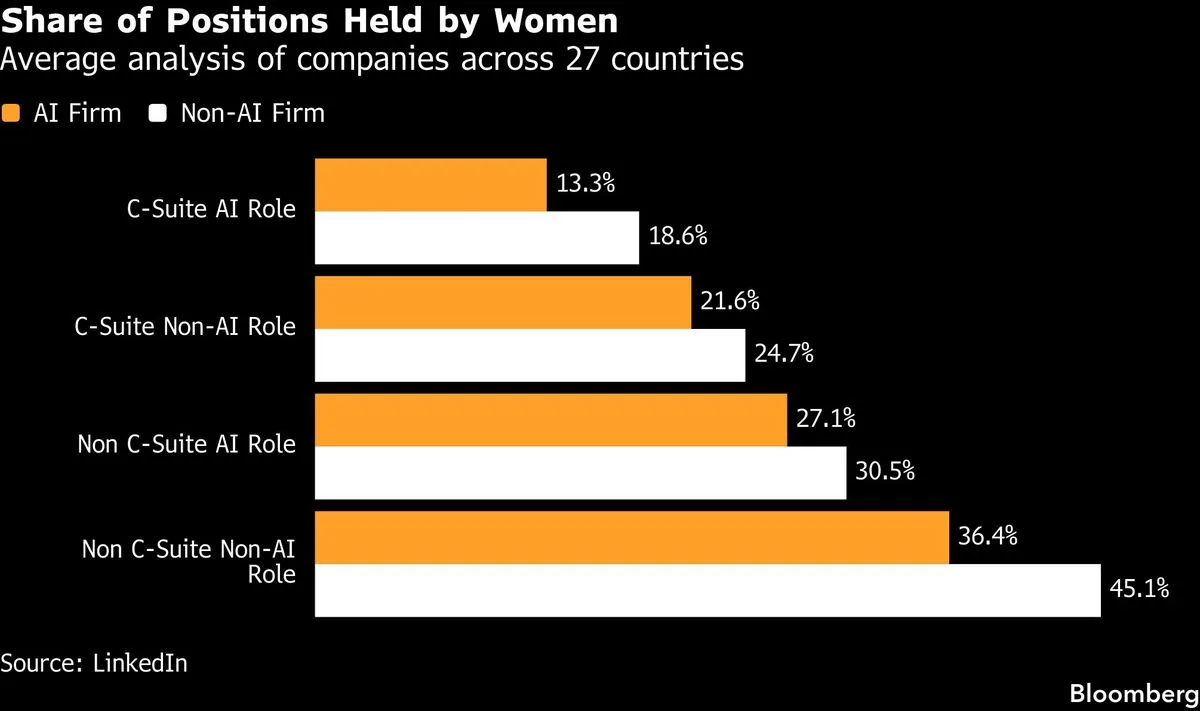
The US AI job market is rapidly expanding with high pay but pronounced gender disparities. In 2025, men filled 74% of new AI roles in the US, leaving women with 26%, compared with nearly 50% female hires in non-AI fields [1]. Globally, women hold just 13% of executive roles at AI companies, lower than the 19% in non-AI sectors, and make up 27% of AI roles versus 31% elsewhere [2]. "Women may be included in the AI economy, but not in the roles most likely to drive long-term economic mobility, leadership, and decision-making power," said Sarah Steinberg, head of global public policy partnerships at LinkedIn [1].
The AI sector offers some of the highest wages across the job market. Median annual pay for AI workers is $177,000, more than double the $80,000 median for other roles. Certain technical AI jobs pay even more. For example, the "member of technical staff" role, heavily male dominated at 82% male hires, has a median salary of $223,000 [3, 4, 5, 1]. Conversely, data annotator roles show a gender balance but pay much less, with a median salary of $51,000 [1].
Younger generations have captured a major share of AI hiring. Gen Z workers represent over two-thirds of new hires for roles such as forward deployed engineers and AI engineers, which pay median salaries of $199,000 and $166,000 respectively [3, 4, 5]. Millennials hold about 60% of new head of AI leadership jobs, earning a median $236,000 [3, 4, 5]. Kory Kantenga, LinkedIn’s Head of Economics, Americas, said, "Some young workers have been able to take advantage of this moment to secure high salaries and to move into leadership positions" and called the robust uptake by young workers "surprising" [3].
Education remains a key factor. About 91% of AI workers have a university degree or higher, with advanced degrees more common in leadership roles [4, 5]. LinkedIn recommends computer science degrees and experience with data handling as essential for young workers seeking AI careers [4].
Steinberg warned that the lack of gender diversity and barriers to education risk excluding many women and could reinforce inequalities in AI's economic benefits. She said, "The AI economy risks being shaped without the perspectives and talent of half the workforce" [2].
LinkedIn’s reports published today detail the gender disparities, young worker dominance, and wage patterns in AI roles, highlighting continuing challenges despite rapid market growth [2, 3, 4, 5, 1].