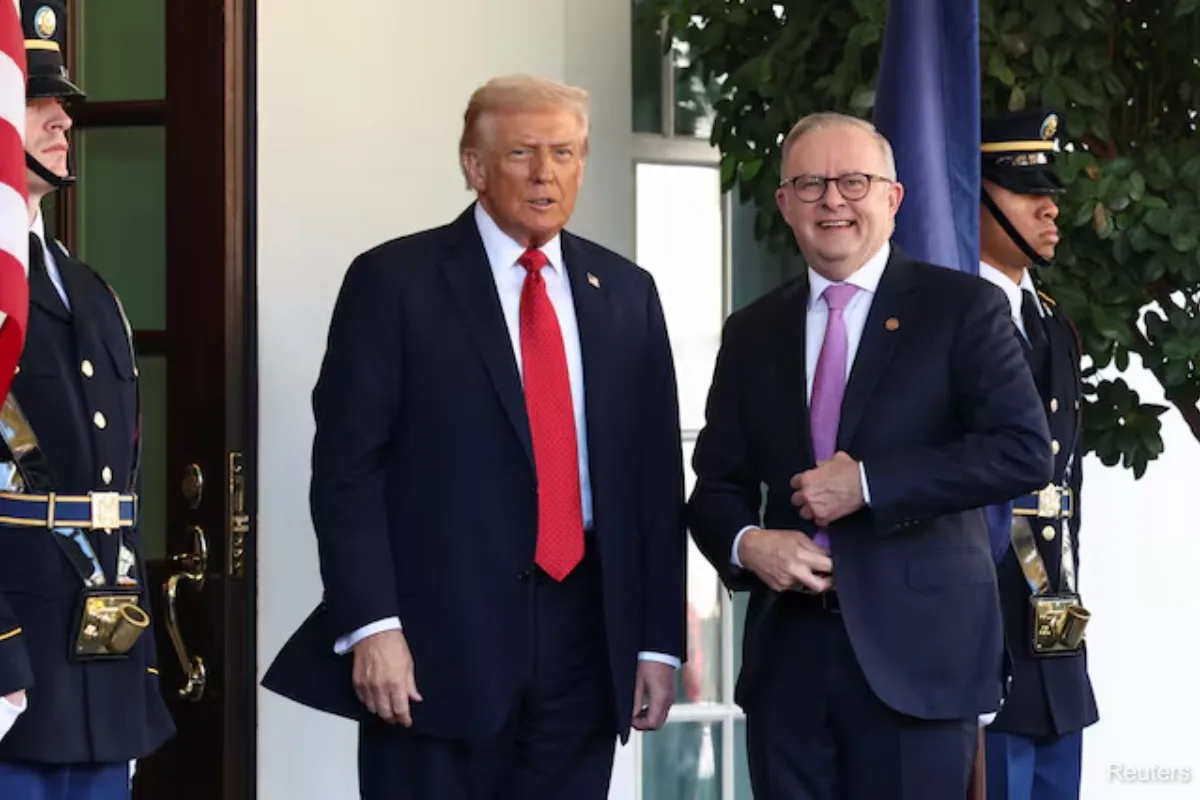
Australian Prime Minister Anthony Albanese held a 40-minute phone call with US President Donald Trump on August 14, urging him to exempt Australia from the 12.5% tariffs imposed by the US in July 2026 over alleged forced labor concerns [1, 2, 3]. Albanese asked for a full exemption or to at least maintain the previous 10% tariff rate, telling Trump, "The ask that I made of the president is that he consider full exemption, or at the very least, no increase" [2].
Albanese described the call as "warm and productive," calling the discussion "productive, constructive and substantial," and "great" [1, 2, 3]. He said he requested that Australia's position as a friend of the United States be taken into account, with Trump agreeing to give the request consideration: "I did ask that Australia's position as a friend of the United States be considered and the president agreed that he would give consideration to my request" [1].
Australia disputes the forced labor basis for the tariffs, stating there is no credible evidence of such practices. Albanese emphasized Australia's efforts against modern slavery during the call [3]. The trade relationship between the two countries has seen a US trade surplus of USD 442 billion over 20 years [3].
The leaders also discussed regional security challenges, including progress on the AUKUS defense pact and conflicts involving Iran in the Middle East [1, 2]. Albanese reiterated Australia's position that Iran should not be allowed to acquire nuclear weapons, saying in the call, "We reviewed the significant progress that has been made under Aukus, which remains full steam ahead" [1]. Albanese added, "I expressed our view that we wanted to see an end to the conflict there" [2].
Australia has committed AUD 368 billion (USD 259.7 billion) over 30 years to AUKUS, the trilateral pact with the US and Britain to deliver nuclear-powered submarines to Australia, including investments in British and US production bases [1].
The US imposed the 12.5% tariffs on Australia and 59 other countries in July 2026, citing concerns about forced labor in supply chains [2, 3]. Albanese’s call comes amid ongoing cooperation between the countries on defense, critical minerals, and artificial intelligence [3].
Following the call, Albanese publicly described the discussion as productive, with Trump agreeing to consider Australia's tariff exemption request [1, 2, 3].