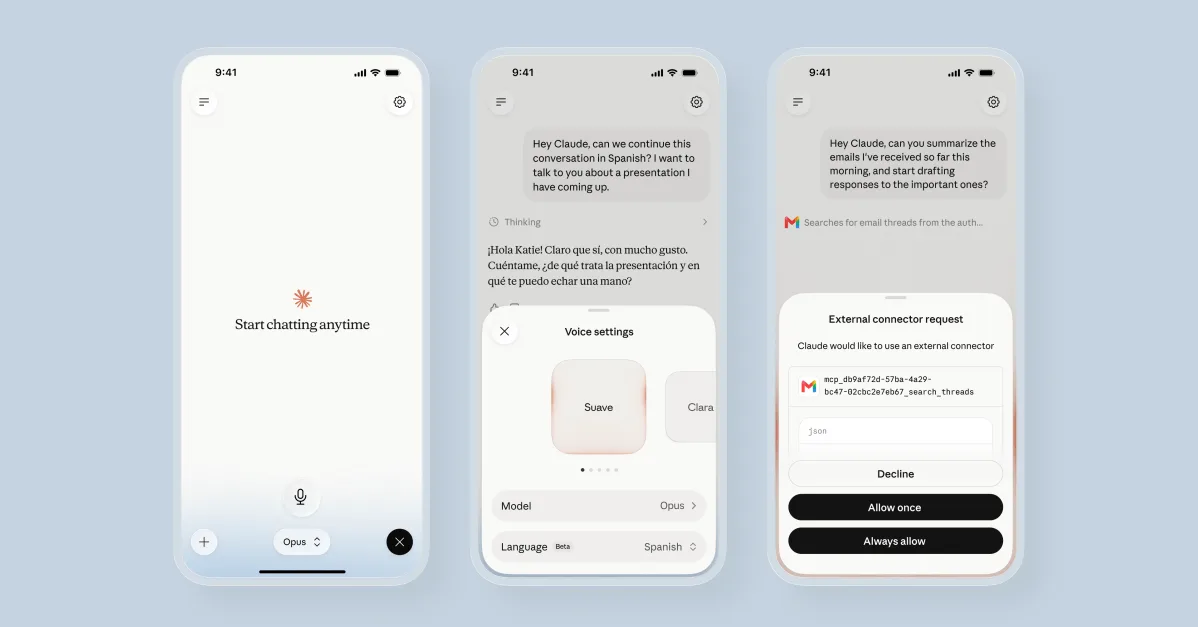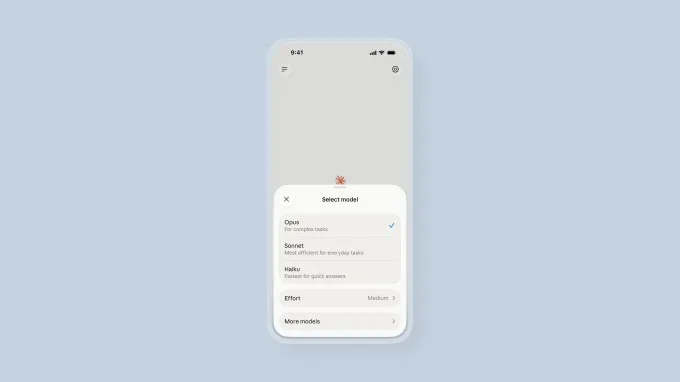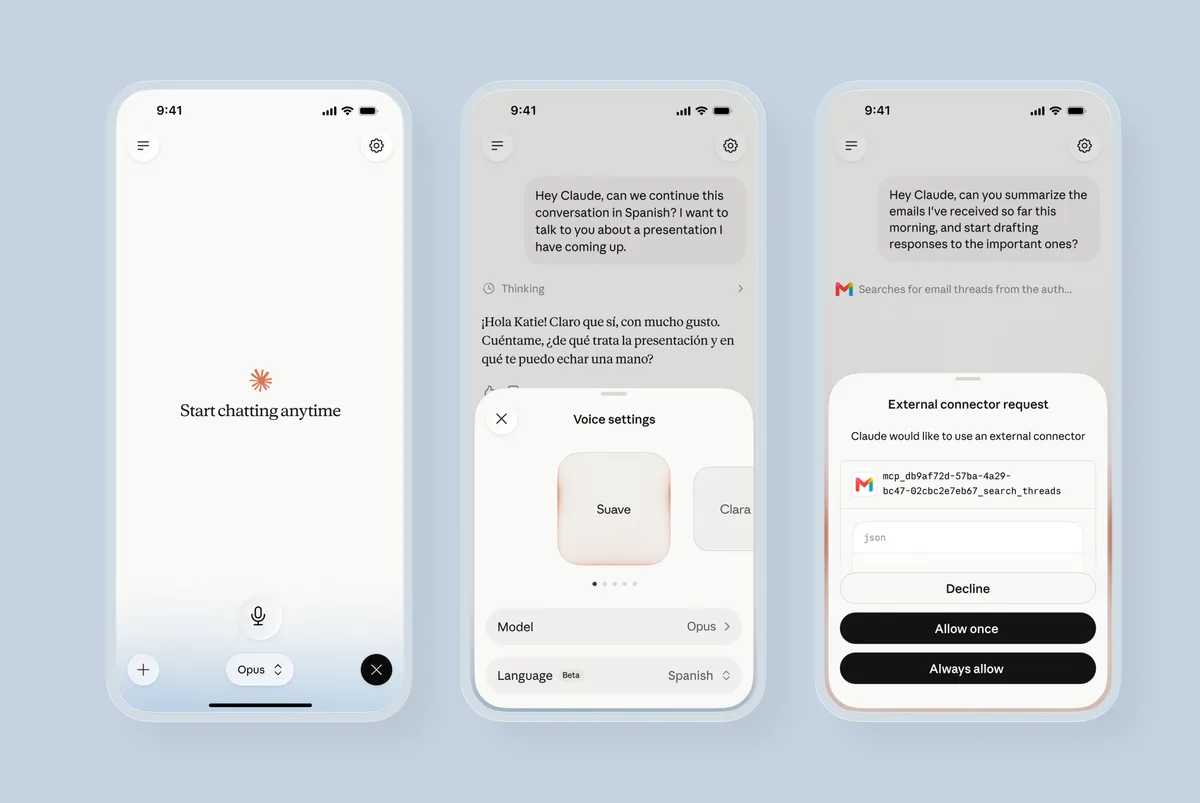
Anthropic announced on July 23 that it has expanded Claude’s voice mode to include its new Opus and Sonnet models alongside the original Haiku model [1]. The update allows users to select from more capable models tailored for complex problem-solving and extended conversations, whereas Haiku was optimized for quick responses [1, 2].
Users can switch between Haiku, Sonnet, and Opus mid-conversation through a model picker, enabling flexibility depending on the interaction’s demands [2, 3]. The voice mode now defaults to the last text chat model a user worked with, running its fastest version to ensure smooth conversation flow. An Anthropic spokesperson said, "Voice mode uses the fastest version of whichever model you've selected, so the conversation runs smoothly" [3].
The updated voice mode integrates with apps such as Gmail, Slack, Canva, Google Calendar, and Notion. This allows voice commands to update meetings, draft emails, and create documents directly within these services [1, 2, 3]. Free account users, however, remain limited to using Haiku with only one connected app [1, 3].
Claude’s voice mode supports multiple languages including English, French, German, Spanish, Hindi, Indonesian, Italian, Japanese, Korean, and Portuguese. Users must manually select or announce language switches as automatic detection is not included [1, 2, 3]. The system uses a turn-based architecture: it listens, pauses to process, then responds. This design contrasts with fully duplex systems like OpenAI’s GPT-Live and can make conversations feel less natural [3].
Anthropic has not disclosed details about the underlying voice technology or implemented conversational improvements such as better interruption handling in this update [1, 3]. An official statement said, "This release is focused on intelligence and tool access. We're continuing to invest in voice and we'll have more to share later this year" [3].
Claude’s expanded voice mode follows its initial beta launch in early 2026, which included the Haiku model and multilingual support [1, 2].