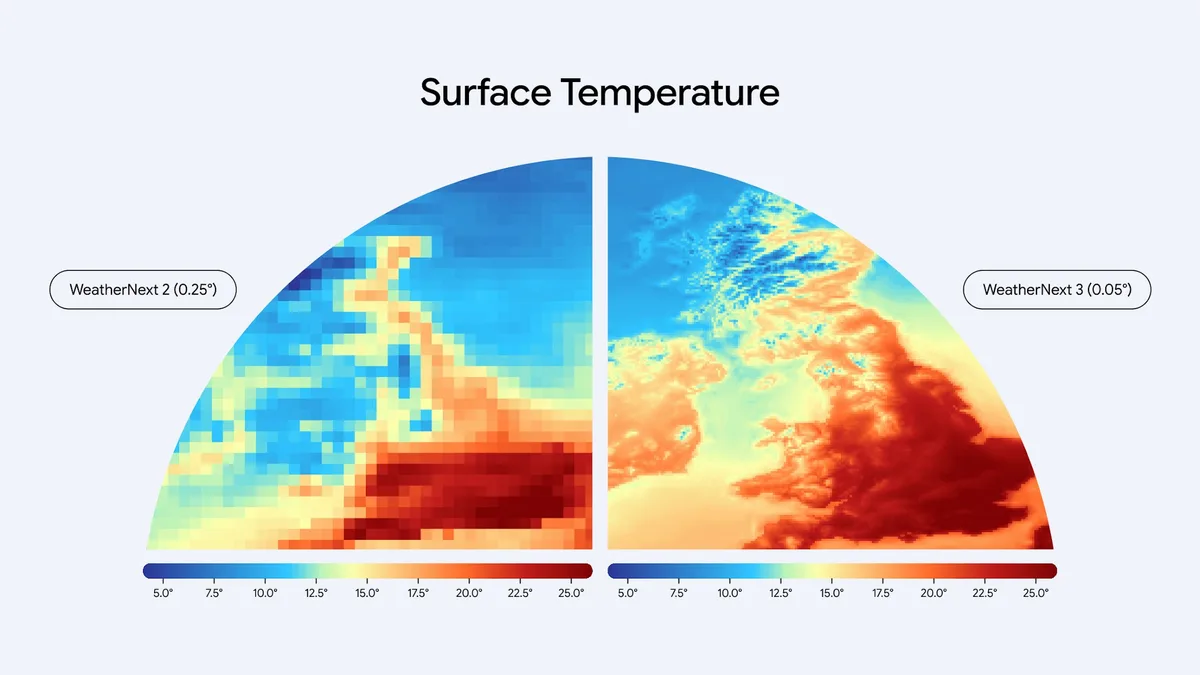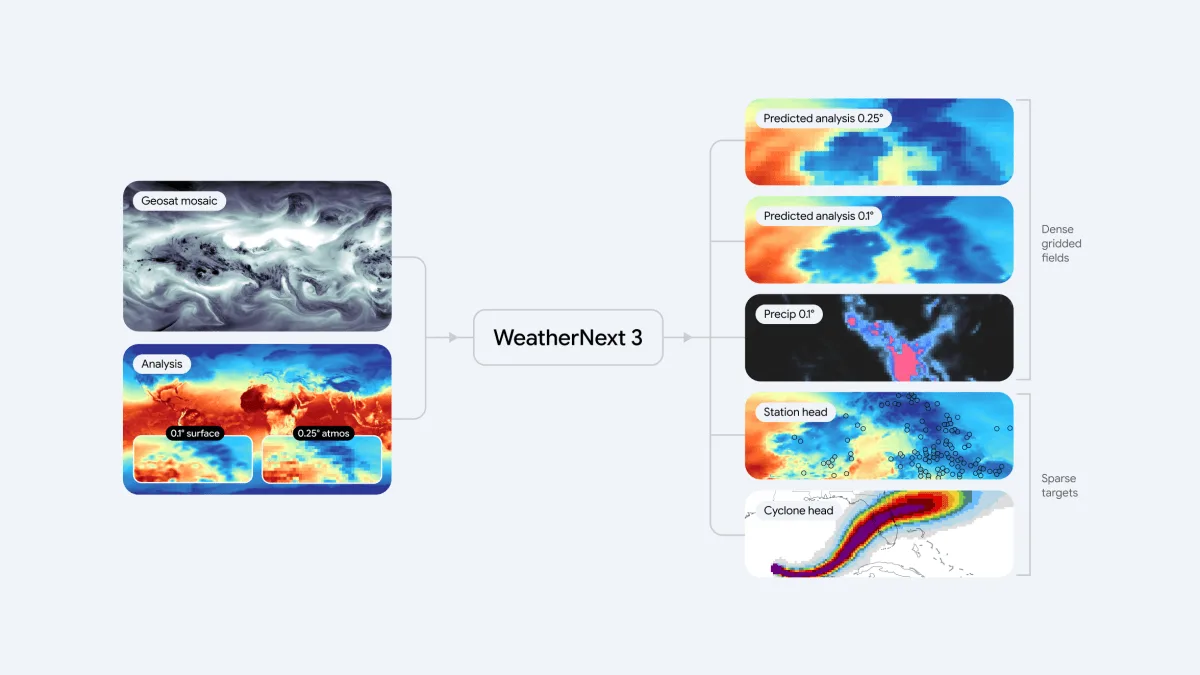
Google DeepMind and Google Research announced the release of WeatherNext 3 on September 3, 2026, an AI weather forecasting model that uses live satellite data to produce forecasts with 5-kilometer spatial resolution, a significant improvement from the previous model’s 25-kilometer grid [1, 2, 3].
WeatherNext 3 updates its forecasts every hour by leveraging real-time satellite observations compared to its predecessor’s six-hour update cycle [2, 3]. The model enhances precipitation predictions by 50-60%, especially for rain and snow, benefiting regions with few weather stations [1, 2, 3].
It predicts key weather variables including temperature, wind speed, humidity, moisture, cloud cover, and solar radiation [1, 3]. Samier Merchant, senior staff engineer at Google, said, "This is going to be the first time that some of the core variables feed and power a lot of the Google products" [1]. Merchant also stated the model is able to utilize "fresher and richer observational data sets" [2]. Ferran Alet, research scientist manager at DeepMind, explained that machine learning helps manage the chaotic and noisy nature of weather by learning patterns from a large amount of data [1].
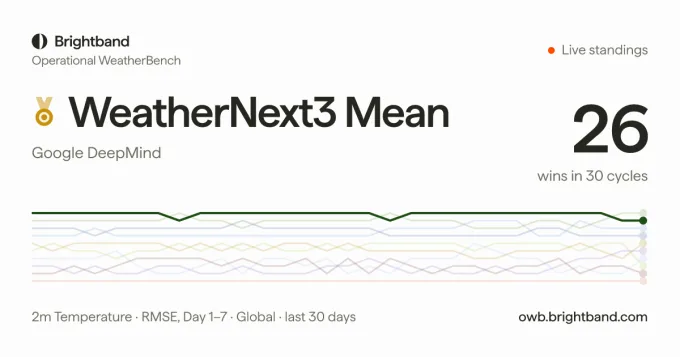
WeatherNext 3 outperforms competing AI weather models by Microsoft, Nvidia, and the European Center for Medium-Range Weather Forecasting, as well as traditional forecasts from the US National Weather Service [1]. It also provides wind forecasts at 100-meter height resolution, aiding renewable energy companies in predicting wind and solar power production more accurately [3].
The model will power weather features across Google products including Search, Maps, the Gemini app, the Google Maps Weather API, and Google Earth Engine. It is also available on Google Cloud for users and researchers to access [1, 3].
In August 2026, Google made the original WeatherNext AI model open-source to allow developers to build upon its technology [3].