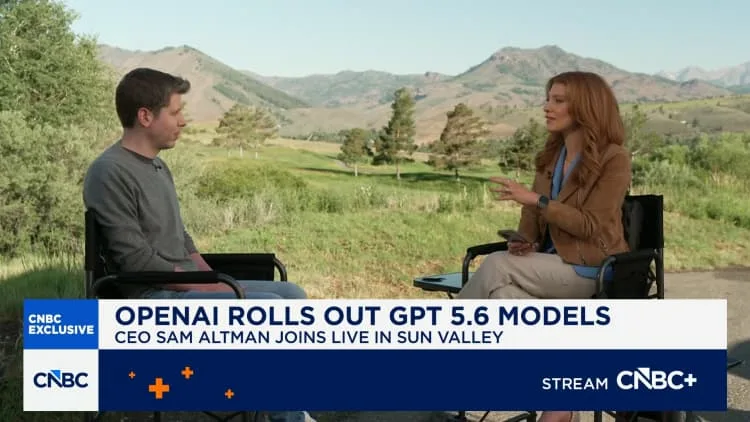
OpenAI released its latest GPT-5.6 AI models—Sol, Terra, and Luna—to a select group of trusted partners on the Thursday before July 9, 2026 [1, 2]. The GPT-5.6 Sol model delivers a 54% improvement in token efficiency specifically on agentic coding tasks, marking a substantial advance in coding-related AI performance [1, 2].
The development prioritized cost efficiency and processing speed, responding to growing enterprise demands for affordable and fast AI solutions [2]. OpenAI CEO Sam Altman said, "Every enterprise now is thinking about spend and the value they're getting in exchange for AI, and this is what we really want to do," emphasizing the focus on cost-effective AI use [1]. He also told CNBC during the Sun Valley conference that "Everyone's asking what we can do to help reduce spend or increase value," underscoring enterprise pressure to maximize AI returns [2].
OpenAI consulted closely with U.S. government officials including Commerce Secretary Howard Lutnick, Treasury Secretary Scott Bessent, and National Cyber Director Sean Cairncross to secure regulatory approval for the launch [1]. The Sun Valley conference from July 7 to 9 also spotlighted AI spending as a major topic, where Altman spoke about the importance of AI efficiency and enterprise value [2].
In the competitive AI market, Meta Platforms recently released its Muse Spark 1.1 AI model and launched its first paid API for enterprises. Meta CEO Mark Zuckerberg said in Chinese that this is their "first serious API launch with competitive and attractive pricing" as it is not an open source model [3].
The GPT-5.6 models remain initially available only to a limited set of trusted partners, with future broader availability yet to be announced [1, 2]. The token efficiency gains are expected to help enterprises reduce costs and increase AI throughput on complex coding tasks, continuing OpenAI’s push towards more efficient AI deployments.