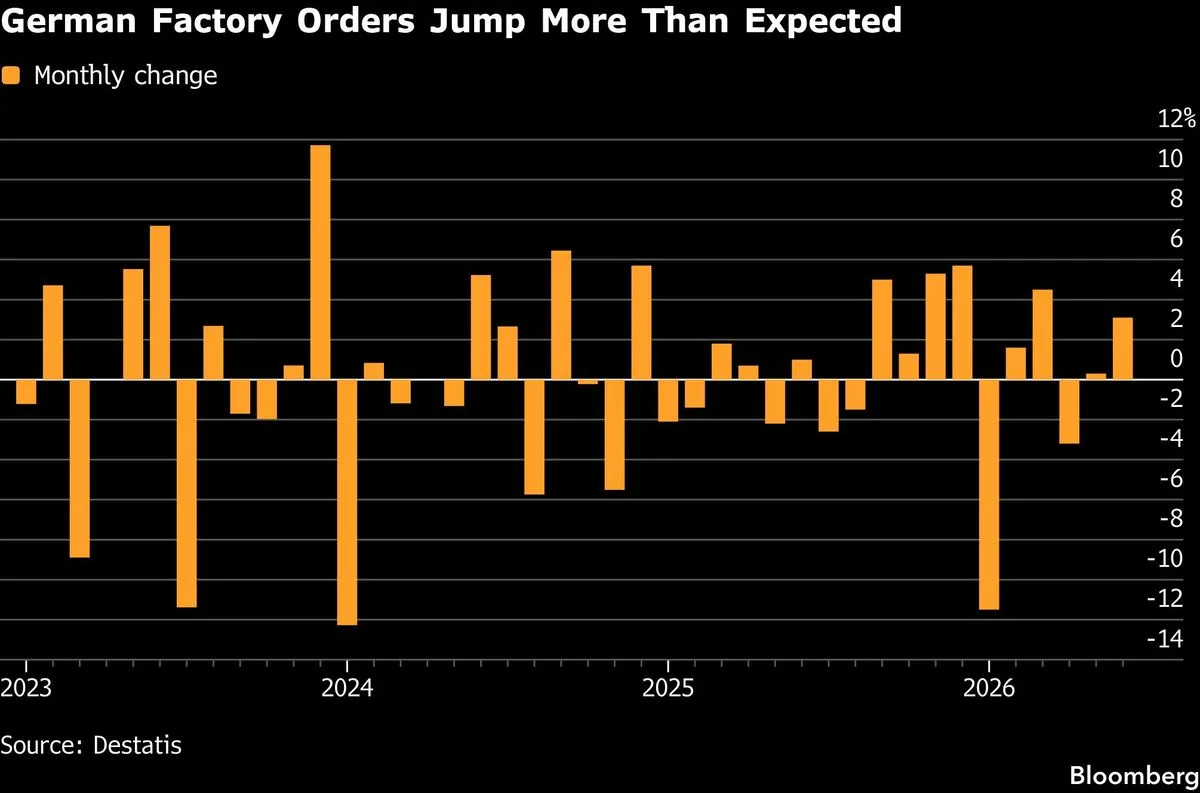
Germany's factory orders increased 3.1% month-on-month in June 2026, significantly exceeding the forecast of about 0.5% [1, 2, 3]. The gain marked a strong rebound after May's orders were revised down to a modest 0.3% increase, from an initially reported 1.9% rise [1, 2, 3]. Excluding large-scale contracts, however, factory orders declined 0.5% in June [1, 2].
Year-on-year, factory orders grew roughly 6.5%, surpassing economists' median forecast of 5.9% [2, 3]. Key sectors driving the increase were mechanical engineering and electronic and optical products [1, 2]. Domestic orders rose sharply by 7.8%, with foreign orders edging up 0.2% [2]. Orders from outside the euro area climbed 10.2%, offsetting a 14% drop from euro-area countries [2]. Vincent Stamer, economist at Commerzbank, said, “The rise in domestic orders is a positive development, as the greatest positive impetus has so far come from the euro area.” [1]
German industrial production volume edged up 0.2% in June, reflecting a moderate monthly gain [4, 5, 6]. Exports climbed 0.9% to a record 139.3 billion euros, the highest level since September 2022 [4, 5, 6]. The automotive and transport sector led production growth and export gains, especially to EU countries [4, 5, 6].
The German Economy Ministry credited growth in capital goods orders partly to public procurement for armed forces modernization and infrastructure projects [1]. Despite strong order figures, energy prices remain elevated due to ongoing conflicts in the Middle East, pressuring Germany's energy-intensive economy [1, 4, 5, 6]. Additionally, record-low Rhine river water levels caused by a heatwave and lack of rain have created logistical challenges, increasing inland shipping costs [1, 4, 5, 6].
The German Economic Institute (BDI) forecasts 2026 real GDP growth around 0.6%, noting a 0.5 percentage point global growth reduction linked to the Iran conflict [4, 5, 6]. Analysts caution that Germany’s industrial and economic outlook remains uncertain and sensitive to energy prices, geopolitical tensions, and weather conditions [4, 5, 6]. ING economist Carsten Brzeski stated, given the risks, “German industry shows surprising resilience,” but its short-term outlook “highly depends on energy prices, the Middle East conflict, and the current heatwave.” [4, 5, 6]
Following June's strong orders and export gains, the coming months will reveal how Germany’s manufacturing base weathers ongoing geopolitical and environmental challenges.