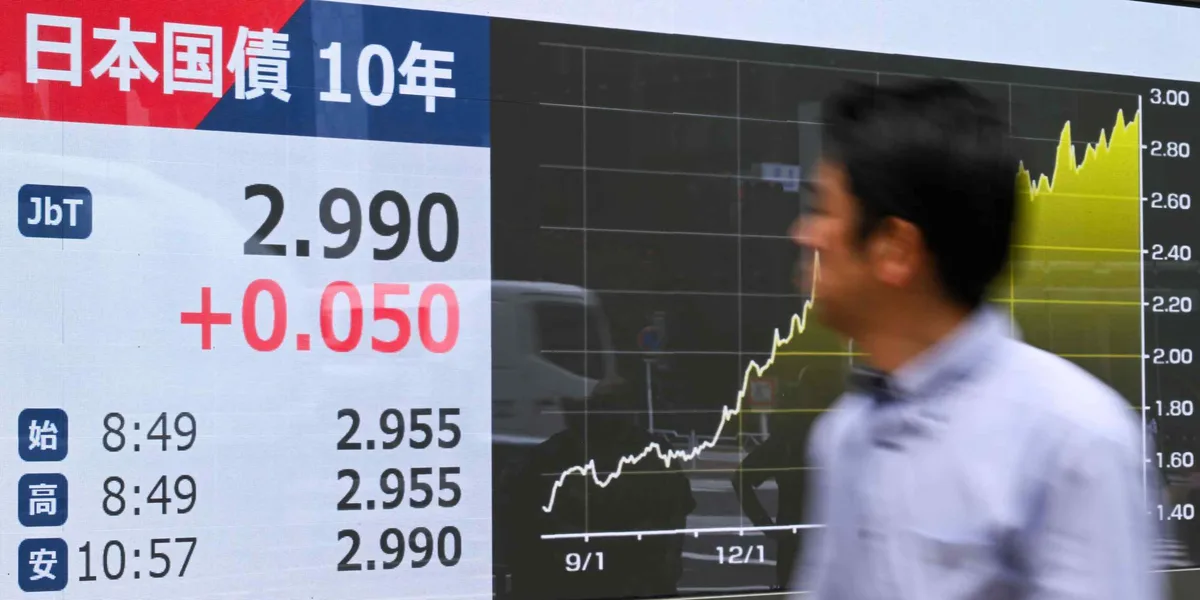
Japan’s benchmark 10-year government bond yield reached 3.000% on September 1, the highest level since October 1996, driven by a global sovereign debt selloff and domestic pressures [1, 2, 3, 4, 5, 6, 7]. At the same time, Japan’s 2-year government bond yield hit a 31-year high of 1.81% [3, 8].
The rise in yields reflects mounting inflation fears and growing fiscal concerns. Japan’s government debt exceeds 200% of GDP, fueling worries about fiscal sustainability. The government’s budget requests for fiscal 2027 reached record levels of about 143 trillion yen ($890 billion), intensifying investor unease [3, 5, 6, 7]. Market participants are also pricing in expectations that the Bank of Japan (BOJ) will accelerate interest rate hikes during its September policy meeting [3, 5, 6, 7]. The BOJ ended its negative interest rate policy in 2024, which has shifted dynamics in Japan’s bond market [3, 6, 7].
Global factors weighed heavily on Japan’s bond yields. Inflation fears, geopolitical tensions driven by the US-Iran conflict, and rising commodity prices, including Brent crude above $90 a barrel, pushed yields to multi-decade highs worldwide [1, 2, 4, 9, 8, 10]. The US 10-year Treasury yield climbed to about 4.79%, the highest since January 2025, while the UK 10-year gilt yield rose to nearly 5.3%, a level not seen since 2008, complicating fiscal planning for London [9, 8, 11, 10].
Japanese investors responded by reducing overseas bond holdings, reversing a long trend of diversification. By August 22, they had sold a net 3 trillion yen ($18.7 billion) in foreign debt, returning capital to domestic bonds. "I know it first hand from talking to Japanese investors. They've underinvested in yen securities for probably 25 years. Now it’s become more attractive and they are reallocating," said Michael Weidner of Lazard Asset Management. Toshinobu Chiba of Simplex Asset Management added, "It’s easy to buy the 10-year at above 3%. Most of the lifers have a strong incentive to buy right now. It’s a natural movement for Japanese investors to pull money out of the U.S. and back into Japan" [12].
Governments have sought to stabilize markets through coordinated currency interventions and bond buybacks between the US and Japan, but these efforts have had limited impact so far [9, 7]. US Treasury Secretary Scott Bessent stated, "I have information that the market doesn’t have, and it’s my belief that the Japanese government and the BOJ will do the things that will lead to a stronger yen" [7].
Markets will closely watch the upcoming Bank of Japan policy meeting in September 2026, where the central bank is expected to announce another interest rate increase amid persistent inflation and fiscal pressures [3, 5, 6, 7].