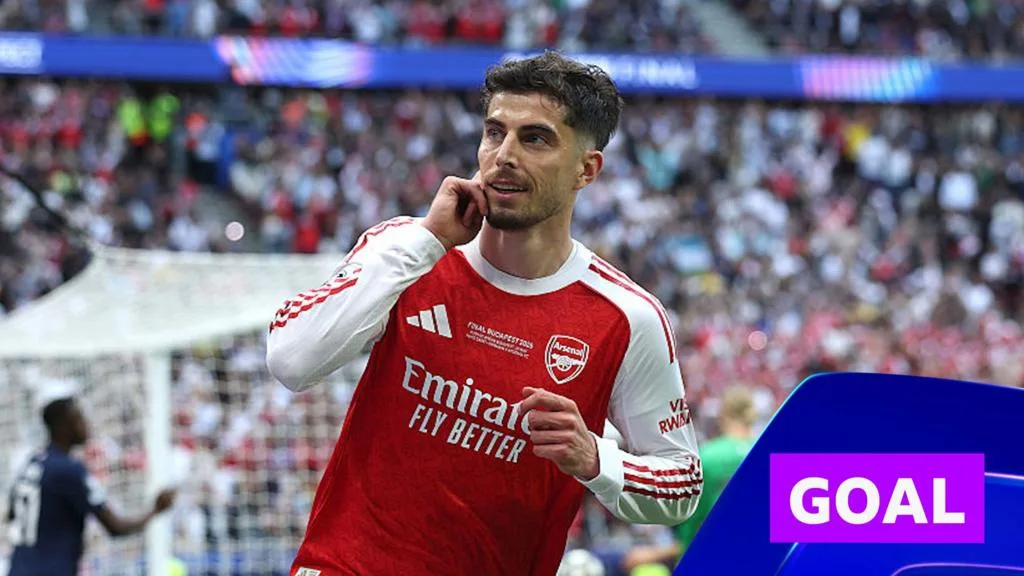
Kai Havertz will start for Arsenal in the Champions League final against Paris Saint-Germain on Saturday in Budapest, marking his second appearance in a European club final since 2021 [1].
Havertz scored the winning goal for Chelsea in the 2021 Champions League final against Manchester City. Reflecting on that moment, he said, "It is something I will never forget. As a kid I could have never dreamed I would score a goal in the final and win that game. I will always be proud of it." He also described playing in the final as "unreal," adding, "There is just so much history with it... to play in it is unreal." [1]
The 2026 final showdown brings a different context for Havertz, who transferred from Chelsea to Arsenal in August 2024 for £65 million [1]. Arsenal have rebuilt since then, winning their first Premier League title since 2004 in the 2025-2026 season [1]. "We were the underdogs on that day, for sure. We hadn’t had the best season. But now it is completely different," Havertz said, reflecting on the contrast between his Chelsea win and the current final with Arsenal. [1]
In recent Arsenal matches against Manchester City and Burnley, Havertz has been preferred over Viktor Gyökeres, showing the club’s confidence in him leading into the final [1]. Despite missing almost five months last season with a knee injury and an additional three months to a hamstring injury, Havertz still finished as Arsenal's top scorer [1].
Manager Mikel Arteta, who brought Havertz to Arsenal, received praise from the German midfielder for his support on and off the pitch. "I am very thankful for that time, how he helped me a lot when I had difficult moments. That is also very important," Havertz said [1]. Celebrating Arsenal’s league triumph, Havertz added, "It is nice that we also got him a little gift [the Premier League title] back now. He brought the club back to where it belongs." [1]
Arsenal and PSG will meet Saturday in Budapest for the Champions League final, with Havertz poised to try to add another decisive moment to his continental career [1].